

A Financial Leader's Guide to Architectural Discipline in AI Investment
The Budget Reality CFOs Are Now Confronting
Enterprise AI spending hit $37 billion in 2025 — and yet 56% of CEOs report that their AI investment has delivered no significant financial benefit: not more revenue, not lower costs. That is not a technology problem. That is an allocation problem.
Gartner has quantified what the balance sheets are already showing: through 2028, at least 50% of GenAI projects will overrun their budgeted costs, driven by poor architectural choices and a fundamental lack of operational discipline. IDC goes further — 96% of enterprises blew their AI budgets in 2025, with costs consistently exceeding forecasts the moment deployments moved from pilot to production.
The source of that overrun is not the model. It is the decision to use a generative model when a simpler, cheaper, and more governable technology would have solved the problem just as well.
Why Inference Is the Budget Item That Spirals
Most finance leaders enter AI conversations focused on training costs. That is the wrong variable to watch.
Model inference — the ongoing cost of running AI in production — accounts for at least 70% of the total lifetime cost of a generative AI deployment, according to Gartner. The training budget is a capital event. Inference is a recurring operational liability that scales with every user, every session, and every automated workflow.
Here is what that looks like in practice. A cloud-based AI tool that costs $200 per month during development has been documented growing to $10,000 per month as user adoption increases. OpenAI's GPT-4 cost roughly $100 million to train — but the estimated cost of serving that model in production runs approximately $700,000 per day, or over $250 million annually. Unlike conventional software with near-zero marginal cost, generative AI carries a meaningful and compounding variable cost with every single request.
For enterprise-level deployments, current API pricing for frontier models ranges from $2.50 to $15.00 per million tokens for input and output respectively, with enterprise RAG pipelines and agentic workflows that use large context windows seeing costs 50x higher per call than a basic query. Route a single question through a multi-agent loop and the cost multiplies further — agents trigger dozens of model calls per user request, each one billed.
The consequence: more than 80% of companies report that AI costs have eroded gross margins by more than 6%, with over a quarter seeing margin drops of 16% or more. Nearly a quarter of IT leaders have busted their AI budgets by more than 50%.
The Cost Stack No Vendor Mentions in the Pitch
Full-cost accounting on generative AI deployments consistently reveals a pattern: vendors lead with the model license. What follows is rarely disclosed upfront.
One documented mid-market deployment breakdown looked like this:
- $200,000 in high-performance computing infrastructure
- $150,000 annually for data governance and quality management
- $180,000 for specialized in-house expertise
- $100,000+ for ongoing model maintenance and retraining
Total realistic deployment cost: $5 million to $20 million for a production-grade generative AI system, including upfront and recurring expenses. A vendor quoting "$50,000 annually" for the platform is describing perhaps 1–5% of total cost of ownership.
Organizations deploying GenAI across more than 75% of departments rely on an average of six vendors to do so — and nearly half of their IT workforce is consumed by managing and stitching those systems together. That is a hidden headcount cost that rarely surfaces in the original business case.
The Decision Framework: Match Technology to Problem, Not to Ambition
The companies that are getting AI economics right are not spending less on AI. They are spending it more precisely. The framework is straightforward: use the simplest technology that reliably solves the problem.
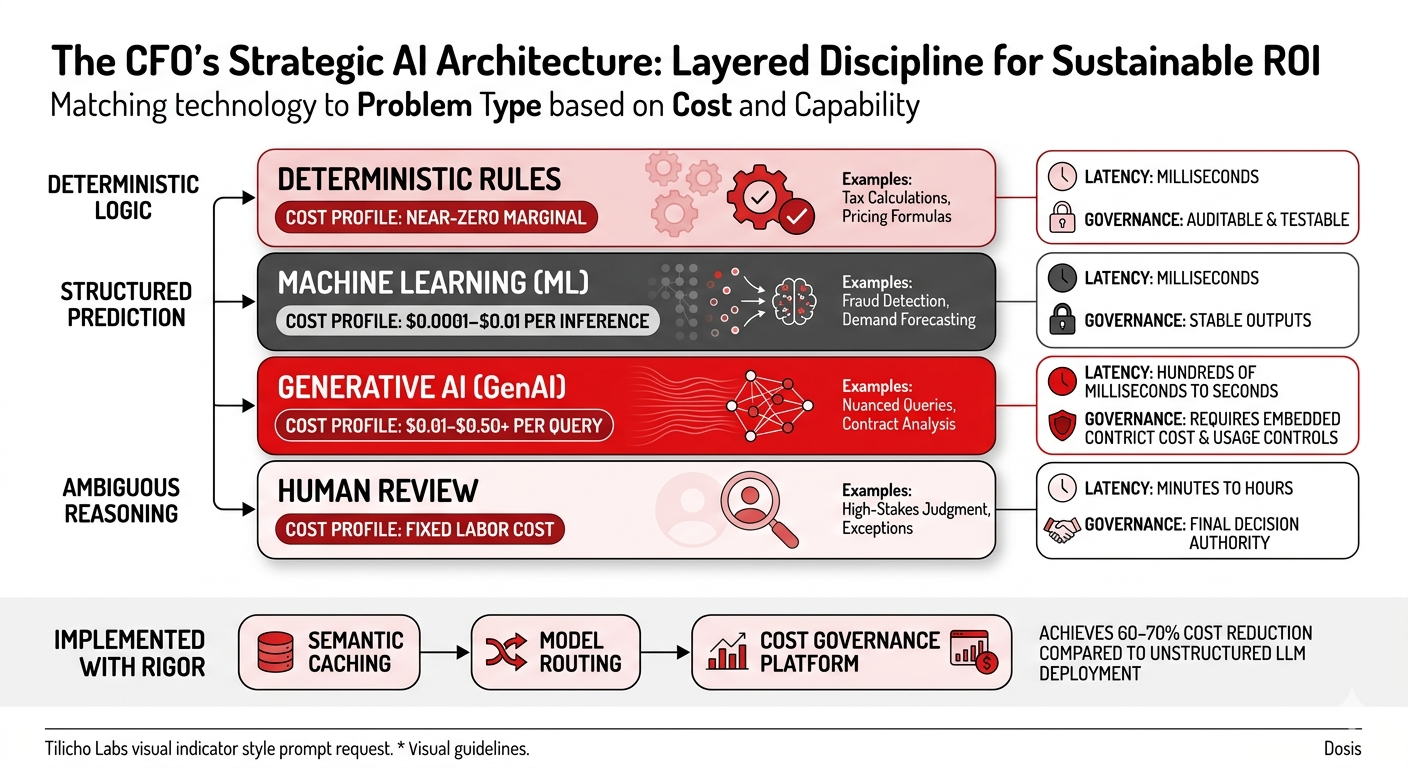
| Problem Type | Correct Tool | Cost Profile | Latency |
|---|---|---|---|
| Known rules, fixed logic | Deterministic algorithm | Near-zero marginal cost | Milliseconds |
| Structured prediction from historical data | Machine learning model | ~$0.001–$0.01 per inference | Milliseconds |
| Ambiguous reasoning, language, unstructured data | Generative AI | ~$0.01–$0.50+ per query | Hundreds of milliseconds to seconds |
| High-stakes judgment calls | Human review | Fixed labor cost | Minutes to hours |
This is not a technology preference. It is margin protection.
Level 1: Deterministic Systems — Where Rules Belong
Tax calculations. Pricing formulas. Approval routing. Access control. Data validation. These problems have answers that are knowable in advance. They do not require prediction or reasoning; they require correct execution of defined logic.
These workloads carry effectively zero marginal cost at scale, are fully auditable, and are straightforward to test and govern. Applying a generative model to a deterministic problem adds cost, latency, non-determinism, and compliance risk — without adding value. At millions of requests per day, that distinction compounds into seven- and eight-figure annual spend.
Level 2: Machine Learning — The Most Underutilized Asset in the Stack
Fraud detection. Demand forecasting. Churn prediction. Recommendation engines. Anomaly detection. Lead scoring. These problems cannot be expressed as explicit rules, but they can be reliably learned from historical data.
A traditional ML model inference costs approximately $0.0001 to $0.01 per prediction on cloud infrastructure, depending on model size and architecture. At one million predictions per day, the difference between an ML model and an LLM-based approach can exceed $400,000 annually — purely in inference charges — before accounting for latency, governance, or reliability.
Machine learning offers strong predictive performance on structured enterprise data, sub-millisecond latency on commodity CPUs, stable and auditable outputs, and governance frameworks that regulators and internal audit teams already understand. It is not a legacy approach. It is the economically correct choice for a large share of the prediction problems enterprises encounter every day.
Level 3: Generative AI — Reserved for Where It Creates Asymmetric Value
Legal research across large document corpuses. Customer-facing agents interpreting nuanced, unstructured queries. Contract analysis. Multi-step workflow automation requiring language comprehension and tool use. These are the use cases where generative AI delivers outcomes that no deterministic rule or prediction model can replicate.
Here, the cost is justified — because no cheaper alternative exists at equivalent quality. The business case is defensible. The ROI is measurable. The enterprises achieving significant AI returns are the ones committing more than 20% of their digital budgets to AI deliberately — not indiscriminately — with clear KPIs and defined boundaries between automated and human-reviewed decisions.
What Happens When Discipline Is Absent
The failure mode is well-documented. Gartner forecasts that over 40% of agentic AI projects will be cancelled by end of 2027 — not because the technology failed, but because of escalating costs, unclear business value, and inadequate risk controls.
Only 23% of enterprises can accurately measure their AI return on investment, despite AI spending approaching $200 billion globally in 2025. The enterprises that cannot measure ROI are, by definition, the ones that cannot defend the spend. 56% of CFOs surveyed cite long time-to-ROI as a top concern about their current AI strategy — and 66% are concerned about security and privacy exposure from models touching sensitive enterprise data.
The structural problem is concentration: teams adopt models independently, no shared governance exists, usage patterns are inconsistent, and no one has visibility into cost-per-workflow. Through 2028, Gartner projects that 50% of GenAI cost overruns will stem from this exact failure — poor architecture and absent operational discipline, not from model limitations.
The Architecture That Delivers Sustainable Returns
The organizations pulling ahead are not the ones with the most AI. They are the ones that built the right layered decision system.
A production-grade layered architecture applies each technology only where it belongs:
- Deterministic rules for known, codified logic
- Machine learning models for structured prediction at high volume
- Generative AI for language, ambiguity, and unstructured reasoning
- Human review for high-stakes, high-risk, or exception cases
Enterprises implementing this architecture — with semantic caching, model routing, and cost governance embedded from day one — are achieving 60–70% cost reductions compared with unstructured LLM deployment, while improving reliability and reducing vendor lock-in risk.
The contrast between governed and ungoverned deployments is already visible in the data. Organizations with GenAI in production for more than one year are 2x as likely to cite end-to-end governance platforms as critical to reaching their AI goals. Early governance investment is not overhead. It is the mechanism that makes the business case hold at scale.
The CFO's Diagnostic Questions
Before approving the next AI budget line, the questions that separate defensible investment from uncontrolled spend:
- What is the cost per query, per prediction, or per automated decision — and how does that scale at projected usage volume?
- Is this a deterministic problem that should be solved with rules, or is ambiguity genuinely present?
- Could a traditional ML model solve this at 100x lower per-inference cost with acceptable accuracy?
- What does inference cost represent at 1 million, 10 million, and 100 million requests per day?
- Is there a governance layer that enforces cost quotas, tracks usage by team and workflow, and surfaces overruns in real time?
- What is the total cost of ownership — including data infrastructure, talent, compliance tooling, and model maintenance — not just the API license?
These are not questions about limiting AI investment. They are questions about ensuring the investment delivers what the business case promised.
The Bottom Line
The rise of generative AI is not making machine learning obsolete. It is making architectural discipline financially mandatory.
The enterprises that will derive sustained value from AI will not be the ones running large models across every workflow. They will be the ones that apply rules where rules work, deploy ML where data can predict outcomes, and reserve generative AI for the problems where its unique capability creates measurable, defensible returns.
The AI leaders of 2027 will be defined not by how much AI they deployed — but by how precisely they knew where not to use it.
The technology is ready. The cost data is clear. The only variable is the discipline to act on it.