

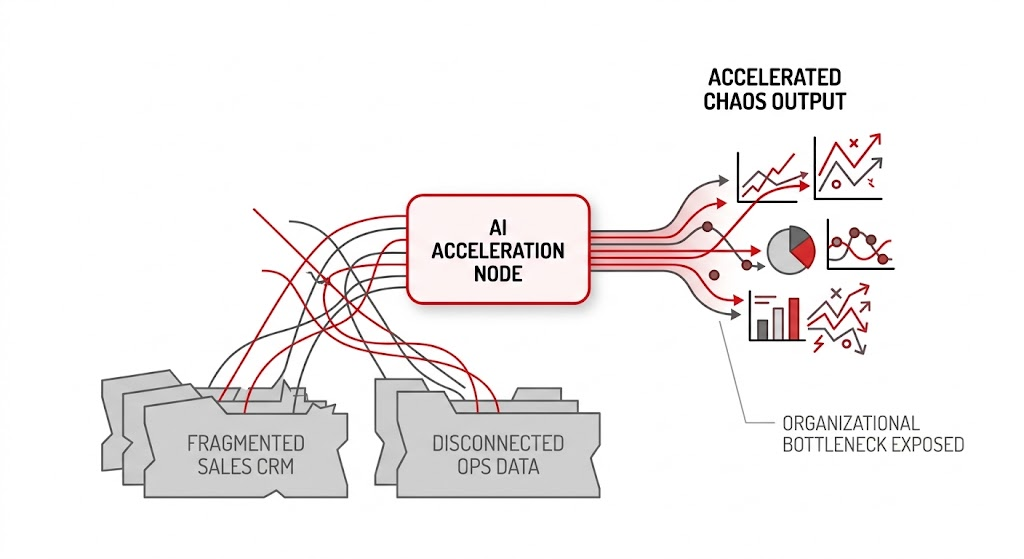
Most organizations think AI adoption is primarily a tooling challenge.
In practice, the first major problems usually appear somewhere else:
inside operational systems that were already fragmented long before AI entered the picture.
The interesting part is:
AI does not create most organizational inefficiencies.
It exposes them.
When teams begin integrating AI into real workflows, hidden inconsistencies become difficult to ignore.
What previously felt manageable through human coordination suddenly becomes operationally expensive.
Organizations start discovering:
- conflicting systems of record
- duplicated operational logic
- undocumented workflows
- inconsistent reporting definitions
- fragmented customer communication
- unclear ownership boundaries
Initially, these issues appear small.
But AI systems depend heavily on:
- structured context
- reliable operational state
- consistent definitions
- predictable workflows
Without that foundation, intelligence becomes unreliable very quickly.
One of the most underestimated problems is operational fragmentation.
In many organizations:
- sales operates in one platform
- operations in another
- customer communication elsewhere
- reporting inside spreadsheets
- critical context scattered across Slack, WhatsApp, or internal calls
Leadership often assumes:
“The organization is digitally mature.”
But once AI systems begin interacting across workflows, the fragmentation becomes visible.
The same customer may exist in multiple states across systems.
Different teams may interpret the same metric differently.
Operational ownership becomes ambiguous.
At that point, the AI model is not the bottleneck anymore.
The organization is.
Another important realization:
Humans are surprisingly good at compensating for broken systems.
Teams often rely on:
- tribal knowledge
- informal escalation paths
- manual coordination
- context carried inside meetings and chat threads
AI systems cannot compensate in the same way.
The moment workflows depend on structured decision-making, organizations discover how much operational knowledge was previously held together informally.
This is usually where AI projects begin slowing down.
Not because the models are weak.
But because the operational layer underneath them is inconsistent.
One pattern we repeatedly see is that organizations initially overestimate how ready their internal systems are for AI.
The assumption is often:
“If we integrate the right AI tooling, productivity improves automatically.”
In reality, AI tends to amplify whatever operational structure already exists.
If:
- workflows are fragmented
- approvals are unclear
- ownership is inconsistent
- reporting systems disagree
- communication lacks structure
then AI often accelerates confusion instead of reducing it.
The companies that benefit most from AI adoption are usually not the ones experimenting with the largest number of models or tools.
They are the ones with:
- cleaner operational systems
- stronger process discipline
- reliable internal data flows
- clearer ownership structures
- better system-of-record maturity
Operational maturity compounds AI effectiveness.
Another shift happening right now is that organizations are being forced to rethink architecture beyond software.
Now the architecture also includes:
- human workflows
- approval systems
- operational visibility
- process reliability
- communication structures
- cross-functional coordination
The technical problem becomes organizational very quickly.
The interesting question is no longer:
“Which AI model should we use?”
Increasingly, the harder question is:
“Can our internal systems support reliable decision-making at scale?”
That requires:
- operational discipline
- process clarity
- systems thinking
- organizational alignment
- clean data boundaries
not just AI tooling.
The organizations that succeed in the next phase of AI adoption will likely not be the loudest ones.
They will be the ones that quietly built operational systems capable of supporting intelligence across teams, workflows, and decision layers.
AI maturity increasingly looks like operational maturity.