

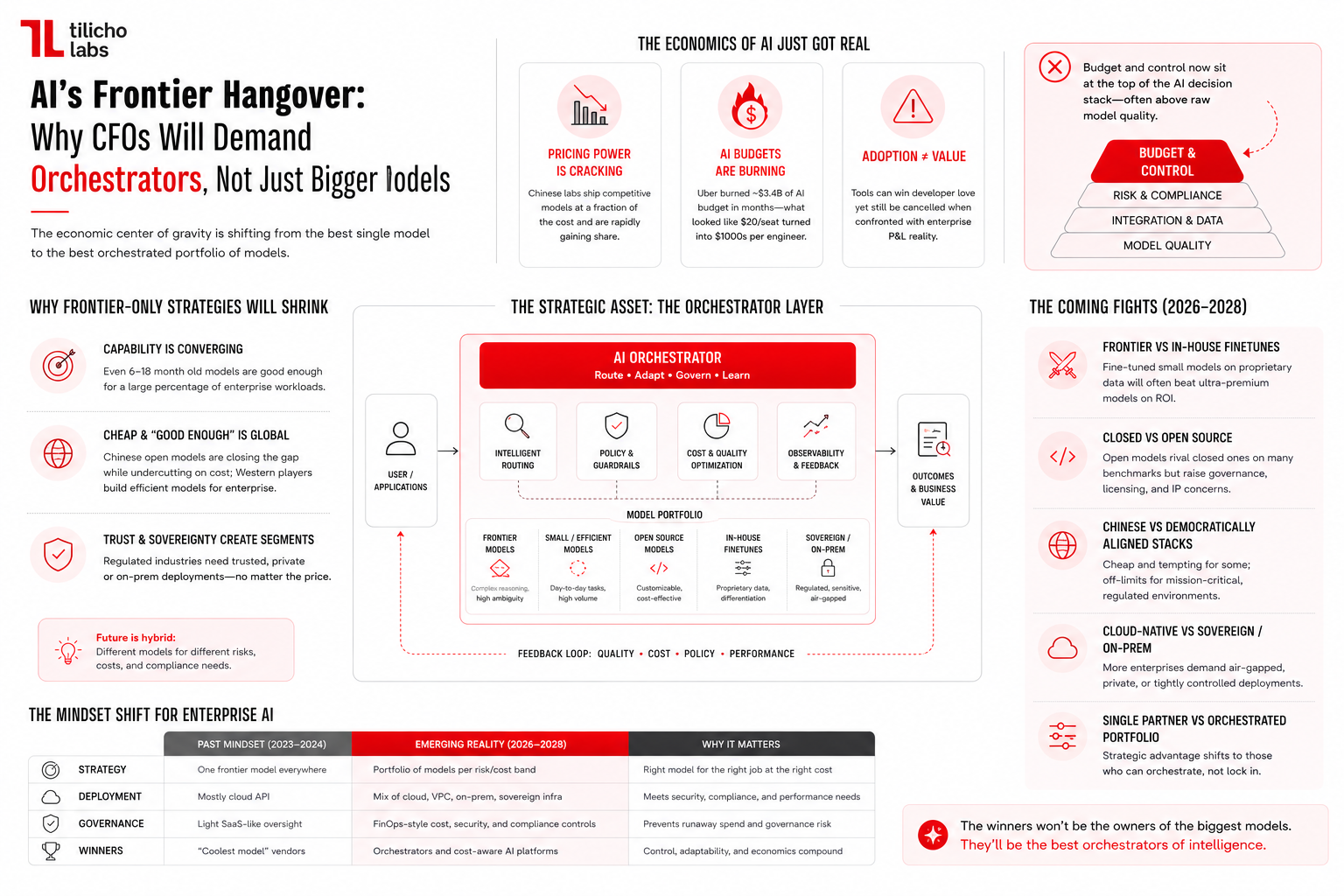
The biggest enterprise AI story of 2026 is not that models are getting smarter. It is that the economics of using them at scale are becoming impossible to ignore. AI may win developer preference, but enterprise adoption is ultimately governed by budget, control, governance, and accountability.
The recent Uber and Microsoft examples around Claude Code make that point sharply. A tool can win developer love and still lose with finance once usage-based costs become visible. The lesson is bigger than any one vendor or model: the next real competitive layer in enterprise AI will not just be better models. It will be better orchestration.
The Uber And Microsoft Signal
Uber’s AI spending became a warning sign for the market when reports suggested that aggressive rollout of Anthropic-powered coding tools consumed the company’s annual AI budget far earlier than expected. Reporting across multiple outlets described internal concern that AI tooling assumptions had already been exceeded within months.
Microsoft’s reported pullback on internal Claude Code licenses sends a similar message. The important point is not whether the tool was technically good. The point is that token-heavy usage changed the economics enough for internal control and budget discipline to override developer enthusiasm.
This is the pattern enterprise leaders should pay attention to. AI does not get constrained because it is useless. It gets constrained because unmanaged adoption creates a new variable cost center that behaves more like cloud infrastructure than traditional SaaS.
The image emerging across the industry is stark: AI tools can achieve strong internal adoption and still fail the enterprise P&L test. Budget and operational control are increasingly sitting above raw model quality in the enterprise decision stack.
Why Frontier-Only AI Breaks At Scale
During the first phase of AI adoption, many companies behaved as though choosing a frontier model was equivalent to choosing a long-term strategy. That made sense for experimentation, but it becomes fragile inside an agentic Software Development Life Cycle (SDLC), where dozens of tasks across requirements, design, coding, testing, triage, release, and support all have very different cost-to-value profiles.
In practice, not every task needs frontier-grade reasoning.
Boilerplate generation, standard documentation, structured transformations, tagging, summarization, and basic test expansion can often run effectively on cheaper open-source or in-house models. Premium frontier inference is most justified for high-ambiguity or high-risk work: complex reasoning, strategic refactoring, multi-step agents, or mission-critical operational tasks.
That distinction matters because cost blowouts rarely happen because of one valuable workflow. They happen when premium models quietly become the default for everything. Once that happens, low-value work gets priced as though every prompt were strategic.
At the same time, capability itself is converging. Models that are six to eighteen months “behind” frontier systems are already good enough for a large percentage of enterprise workloads. As capability converges, cost efficiency, governance, trust, and deployment flexibility start dominating procurement decisions.
This is also where global competition enters the picture. Chinese labs like DeepSeek and Moonshot are shipping increasingly capable models at dramatically lower prices, while enterprise-focused players are building smaller and more efficient models optimized for regulated environments. The result is a market where “good enough” intelligence is becoming widely available and aggressively commoditized.
What Agentic SDLC Actually Changes
Agentic SDLC is best understood not as one giant autonomous agent, but as a coordinated network of specialized agents and tools operating across the full software lifecycle. Microsoft and other industry frameworks increasingly describe AI-led SDLC as an orchestrated system spanning requirements, design, coding, testing, deployment, monitoring, and governance.
Once software delivery is broken into stages, model strategy changes fundamentally.
Requirements analysis may need strong reasoning, but not necessarily the most expensive model. Large-scale scaffolding and repetitive engineering tasks may run perfectly well on cheaper models. Production incident triage or security-sensitive operations may justify top-tier inference because the business impact is materially higher.
This naturally pushes enterprises toward a portfolio approach instead of a single-model strategy.
PwC’s 2026 work on agentic SDLC reflects this shift clearly. As organizations mature in AI adoption, cost efficiency becomes dramatically more important. Enterprises move from experimentation toward operational accountability, where leadership expects measurable productivity, quality, and financial outcomes rather than generalized AI activity.
The Future Is Hybrid
The future of enterprise AI will almost certainly be hybrid. Frontier models will remain important, but they will be used more selectively as open-source, regional, sovereign, and in-house alternatives improve.
Several overlapping battles are already shaping that future:
- Frontier models vs in-house fine-tunes
- Closed models vs open source
- Chinese stacks vs “democratically aligned” infrastructure
- Cloud-native AI vs sovereign and on-prem deployments
For non-regulated, cost-sensitive workloads, cheaper models will become increasingly attractive. But regulated sectors such as banking, healthcare, utilities, defense, and critical infrastructure will continue prioritizing governance, trust, sovereignty, and deployment control over pure cost efficiency.
That means a single “strategic model partner” increasingly becomes a liability rather than a strength. The real strategic asset becomes the orchestration layer that can intelligently route work across multiple models and deployment environments.
Why The Orchestrator Becomes The Real Platform
The answer to rising AI costs is not retreating from AI. It is introducing an enterprise orchestrator that routes work to the right model based on complexity, cost, sensitivity, confidence, jurisdiction, and business risk.
In practice, that means:
- Simple and repetitive tasks default to cheaper models
- Domain-specific work may run on private or in-house models
- Frontier models are reserved for narrow bands of high-value work
An orchestrator also becomes the enterprise control plane for governance and policy enforcement. It can encode rules around regulated workloads, geographic restrictions, approved vendors, escalation thresholds, and sensitive data handling. Governance stops being a presentation topic and becomes executable infrastructure.
Just as importantly, orchestration creates the visibility CFOs and CIOs need.
Today, many organizations discover AI overruns only after the quarter closes. An orchestrator should expose real-time telemetry:
- Cost per workflow
- Cost per engineer
- Cost per product area
- Cost per successful outcome
- Token spend by model
- Productivity-to-spend trends
Leadership teams should be able to ask questions like:
Which 10% of workflows are generating 60% of our AI bill?
Can those workflows shift to cheaper models without hurting outcomes?
The orchestration layer also becomes the mechanism for continuous benchmarking. It can routinely evaluate frontier, open-source, and internal models against real enterprise workloads and rebalance routing as economics and quality change.
This is how enterprises prevent vendor lock-in while adapting to a market where capability and pricing shift quarter by quarter.
The CFO Era Of AI
From a finance perspective, the lesson is not to slow down AI. It is to professionalize it.
A few practical implications follow naturally:
- Treat AI as variable COGS, not just SaaS licensing
- Assume usage-based pricing will materially exceed seat-price assumptions
- Introduce orchestration and routing layers early
- Define model tiering policies by workload and sensitivity
- Instrument ROI at the workflow level, not the initiative level
Every serious AI initiative should eventually answer questions like:
- Cost per resolved support ticket
- Cost per validated line of code merged
- Cost per deal supported
- Cost per production issue prevented
The enterprises that succeed will still use frontier models. But they will use them as a scalpel, not a hammer.
The Next Competitive Layer
The biggest shift happening in enterprise AI is subtle but foundational. The economic center of gravity is moving from:
“Who has the best single model?”
to:
“Who can orchestrate the best portfolio of models?”
The winners will not simply be the companies with access to the smartest frontier system. They will be the organizations that can combine agentic SDLC thinking with orchestration, governance, visibility, benchmarking, and ruthless cost discipline.
Future enterprise AI leaders will run AI the same way strong companies run finance portfolios: with routing, controls, optionality, observability, and operational discipline.
That is why the strategic conversation is already shifting from model selection to model orchestration.