

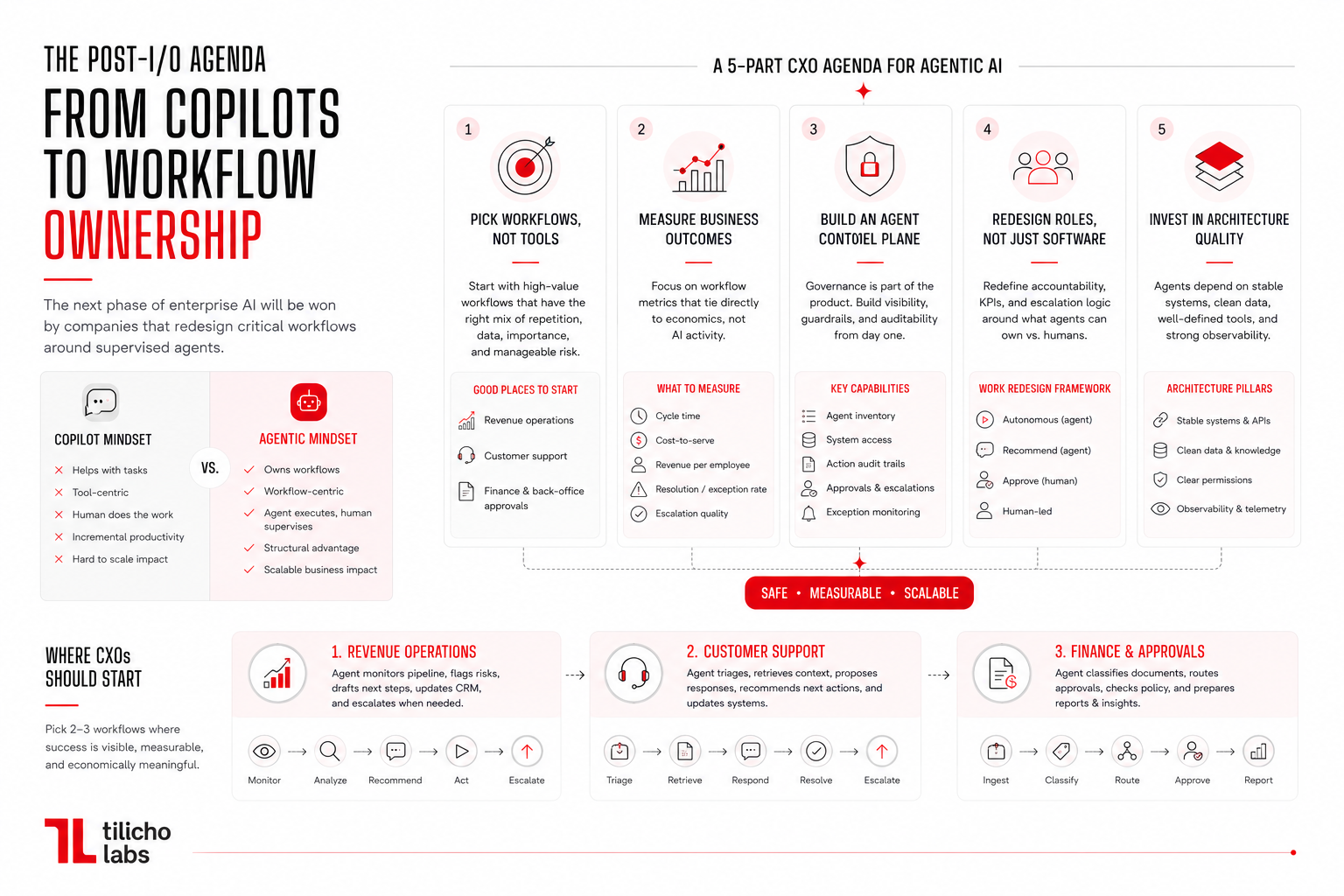
Google I/O 2026 made one thing clear: the next phase of enterprise AI will not be won by companies that deploy the most copilots. It will be won by companies that redesign a small number of critical workflows around supervised agents.
That distinction matters because most organizations are still optimizing at the wrong level. They are buying tools, enabling pilots, and measuring local productivity improvements. Useful, yes. Transformative, no.
The real opportunity is to move from task assistance to workflow ownership.
The executive mistake to avoid
The most common executive mistake right now is treating AI as another software category. That leads to familiar but limited conversations.
- Which assistant should the sales team use?
- Should finance get a document summarizer?
- Can support use AI to draft responses?
Those are reasonable starting points, but they are not strategy. They are tooling decisions.
The strategic question is different: where can the company redesign an end-to-end business process so that supervised agents own meaningful parts of the workflow, while humans retain accountability, approvals, and exception handling?
This is the difference between incremental productivity and structural advantage.
What a post-I/O CXO agenda should look like
Google’s announcements point to a future in which models, agents, tools, interfaces, and governance work together as one operating environment. For CXOs, that means the right response is not “deploy more AI.” It is “build the conditions under which agentic execution becomes safe, measurable, and scalable.”
That agenda usually has five parts.
1. Pick workflows, not tools
The first move is to stop thinking in terms of AI features and start thinking in terms of business workflows.
A copilot helps with a step. An agent can own a flow.
That means the right starting point is not “where can we add AI?” It is “which workflow has the right mix of repetition, data availability, economic importance, and manageable risk?”
Three good places to start are:
- Revenue operations
- Customer support and service delivery
- Finance and back-office approvals
Each of these areas has enough structure to be automatable, enough volume to produce measurable value, and enough friction that leadership will notice the difference if execution improves.
2. Measure business outcomes, not AI activity
One of the fastest ways to waste money in enterprise AI is to celebrate activity that is not tied to economics.
A leadership team does not need more dashboards showing prompt volume, active users, or how many summaries were generated. It needs to know whether revenue velocity improved, support resolution time dropped, cash flow tightened, or operating cost declined.
If an AI initiative cannot be tied to workflow metrics, it should not be treated as a transformation program.
The right metrics usually live at the level of:
- Cycle time
- Cost-to-serve
- Revenue per employee
- First-contact resolution
- Exception rate
- Escalation quality
That is how CFOs and operating leaders should force clarity.
3. Build an agent control plane early
One of the biggest misconceptions in the market is that governance can be added later. It cannot.
Once agents start acting across systems, governance becomes part of the product. Organizations need a control plane that can answer simple but critical questions:
- Which agents are running right now?
- What systems can they access?
- What actions did they take?
- Which actions required approval?
- Where are exceptions increasing?
- How do we audit behavior after the fact?
Without this layer, enterprises will create fear faster than they create value.
4. Redesign roles, not just software
The rise of agents does not just change tools. It changes work.
If a revenue agent can continuously monitor opportunities and prepare the next action, the role of the sales manager shifts. If a support agent can handle triage and first-pass resolution, the role of the support lead shifts. If a finance agent can classify documents and route approvals, the role of operational finance shifts.
This is where many AI programs fail. They deploy technology without redesigning accountability, escalation logic, KPIs, or training. The result is confusion, duplication, and resistance.
The better approach is to explicitly redefine work around four categories:
- What the agent can do autonomously
- What the agent can recommend but not execute
- What the human must approve
- What remains entirely human-led
That clarity reduces organizational friction and accelerates adoption.
5. Invest in architecture quality
The companies that succeed in agentic AI will not necessarily be the ones with the most experiments. They will be the ones with the cleanest architecture.
Agents depend on stable systems, well-defined tools, clear permissions, reliable knowledge sources, and strong observability. Weak APIs, messy data contracts, inconsistent workflows, and fragmented permissions do not just slow projects down. They directly undermine reliability.
This is why the post-I/O conversation should not be limited to AI budgets. It must include API quality, data readiness, knowledge architecture, control design, and operating discipline.
Where CXOs should start
A realistic executive response over the next 12 months is not to launch 25 pilots. It is to pick two or three workflows where success is visible, measurable, and economically meaningful.
Here is a sensible sequence.
Revenue operations
Build a supervised revenue agent that monitors pipeline changes, highlights at-risk deals, drafts next-step outreach, updates CRM context, and escalates when thresholds are crossed.
Why start here? Because the metrics are visible, the workflows are repetitive, and the upside is tied directly to growth.
Customer support
Build a resolution agent that triages inbound cases, retrieves relevant context, proposes responses, recommends next actions, and updates the knowledge base when new patterns emerge.
Why start here? Because support contains high-volume repetitive work, expensive handoffs, and abundant historical data.
Finance and operations
Build an approvals or payables agent that ingests documents, validates fields, routes exceptions, summarizes anomalies, and supports a clean audit trail.
Why start here? Because the work is rules-heavy, document-rich, and directly linked to cost and control.
The real post-I/O takeaway
The most important implication of Google I/O 2026 is not that Google has more AI products. It is that the market now has a clearer reference model for how agentic execution will work at scale.
For CXOs, the implication is direct. Stop thinking in terms of AI features. Start thinking in terms of agent-enabled operating models.
The winners in the next phase will not be the companies with the most assistants. They will be the ones that redesign a few important workflows, build the control layer early, measure outcomes rigorously, and adapt their organization around the new reality.
That is what leadership looks like in the agentic era.