

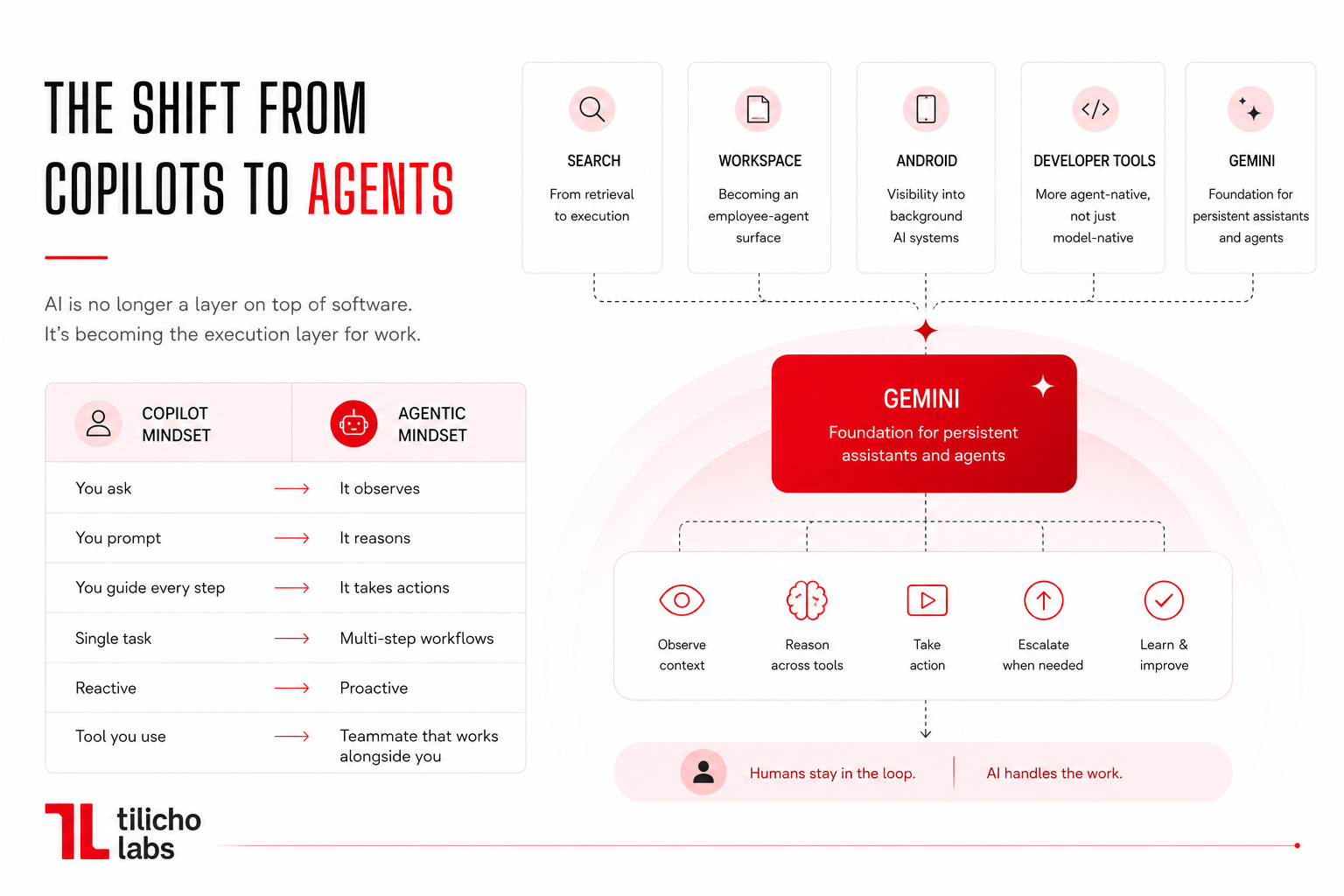
Google I/O 2026 was not important because it introduced more AI features. It mattered because Google showed, with unusual clarity, that the industry is moving from isolated copilots to production-grade agents that can operate across systems, workflows, and interfaces at scale.
That is the real headline. Not better chat. Not smarter search. Not more AI in more places. The real shift is that AI is no longer being presented as a layer on top of software. It is being positioned as a new execution layer for work itself.
For the last two years, most enterprise AI conversations have been trapped in the copilot frame. Add a helpful assistant to email. Add a summarizer to documents. Add a chat interface to internal knowledge. Those moves create value, but they do not fundamentally change how an organization operates.
What Google showed at I/O is the next step. The market is moving from AI that helps people do tasks to AI systems that can monitor context, reason across tools, take action, and escalate when needed. That is a very different category of change.
The signal beneath the event
Every major technology cycle creates noise before it creates clarity. Product launches get attention. Demos get headlines. But what matters to business leaders is the pattern underneath them.
At I/O 2026, the pattern was clear: Google is formalizing the move from copilot software to agentic systems.
You could see it across the event:
- Gemini is being positioned not just as a model family, but as the foundation for persistent assistants and agents.
- Search is moving beyond retrieval toward execution.
- Workspace is becoming an employee-agent surface.
- Android is introducing visibility into what background AI systems are doing.
- Developer tooling is becoming more agent-native, not just model-native.
Put differently, Google is not merely putting AI inside products. It is redesigning products around the assumption that AI systems will act inside them.
That is the part executives should pay attention to.
From copilots to agents
Most organizations still think about AI as a tool employees invoke when they need help. That model is already becoming outdated.
The more important model is this: the employee increasingly works alongside long-lived software agents that can observe, draft, recommend, trigger actions, and in some cases complete bounded tasks autonomously. The human is still accountable, but the machine is no longer just waiting for prompts.
A simple way to make this shift tangible for a leadership team is to put the copilot mindset and the agentic mindset side by side.
| Dimension | Old copilot mindset | Agentic mindset |
|---|---|---|
| Scope of work | Single step, such as drafting an email or suggesting text | End-to-end workflow, such as monitor, act, and escalate |
| Lifecycle | Runs on demand when someone prompts | Long-lived and always on within clear boundaries |
| Success metric | Minutes saved on individual tasks | Business KPI shift across cycle time, NPS, revenue, or risk |
| Integration surface | One app, such as an email client, IDE, or chat window | Multiple systems via tools, APIs, and MCP |
| Governance | Feature toggles and settings | Policies, logs, approvals, and an agent control plane |
Organizations that stay in the left column will collect useful tools. The ones that move decisively into the right column will change how work actually gets done.
This is why the event matters. Google is helping normalize the idea that the next generation of enterprise software will not be built around screens alone. It will be built around coordinated interactions between people, applications, and agents.
What the announcements really mean
A lot was announced at I/O, but only a few threads matter strategically.
Gemini 3.5 makes AI deployment more practical
When a model family becomes fast and cheap enough to sit inside mainstream products at scale, the economics change. Gemini 3.5 Flash matters less as a model name and more as a signal that Google believes AI can now sit inside high-frequency, production-grade flows without breaking the cost or latency budget.
That is what enterprises should notice. Once the economics become viable, AI stops being a premium experiment and starts becoming a default design assumption.
Search is moving from answers to actions
Search is no longer just about finding information. It is increasingly about helping users complete tasks. When search begins tracking, filtering, comparing, and initiating actions on behalf of users, the implications spread far beyond Google’s interface.
It means customer journeys are starting to shift away from direct brand interaction toward AI-mediated interaction. In the coming years, many companies will need to optimize not only for human discovery, but also for machine-led discovery and machine-initiated transactions.
Workspace is becoming an operating surface for employee agents
This may be the most underappreciated part of the event. Once email, calendars, documents, and task flows are connected to persistent AI systems, the shape of knowledge work starts to change.
The employee no longer begins every day from a blank slate. A well-designed agent can monitor developments, surface priorities, summarize context, and prepare the next best actions. That shifts the role of the worker from information gathering toward supervision, judgment, and exception handling.
Trust is moving into the product layer
Android Halo and similar transparency patterns matter because background AI systems will not be trusted unless their behavior is visible. This is a major point that many companies still underestimate.
In the first wave of AI, trust was treated as a governance issue. In the next wave, trust becomes a product requirement. If users and administrators cannot see what an agent did, why it did it, and what permissions it used, adoption will stall.
Why this matters to executives now
If you are a CEO, CIO, CFO, or operating leader, the most important lesson from Google I/O 2026 is simple: AI is no longer just a productivity feature. It is becoming an execution layer.
That changes the questions leadership teams should ask.
The old questions were:
- Which AI tools should we buy?
- Which teams should pilot copilots?
- How do we enable secure experimentation?
The new questions are:
- Which workflows are ready for supervised agents?
- What platform capabilities do we need before agents can operate safely at scale?
- Where will AI materially change cost structure, service quality, and speed of execution?
This is not a subtle shift. It is a change in operating model.
Companies that continue treating AI as a feature roadmap item will improve around the edges. Companies that treat it as a new layer of execution will redesign how work actually happens.
That is why Google I/O 2026 matters. It was not the event where AI got more impressive. It was the event where AI stopped looking like a feature and started looking like infrastructure.