

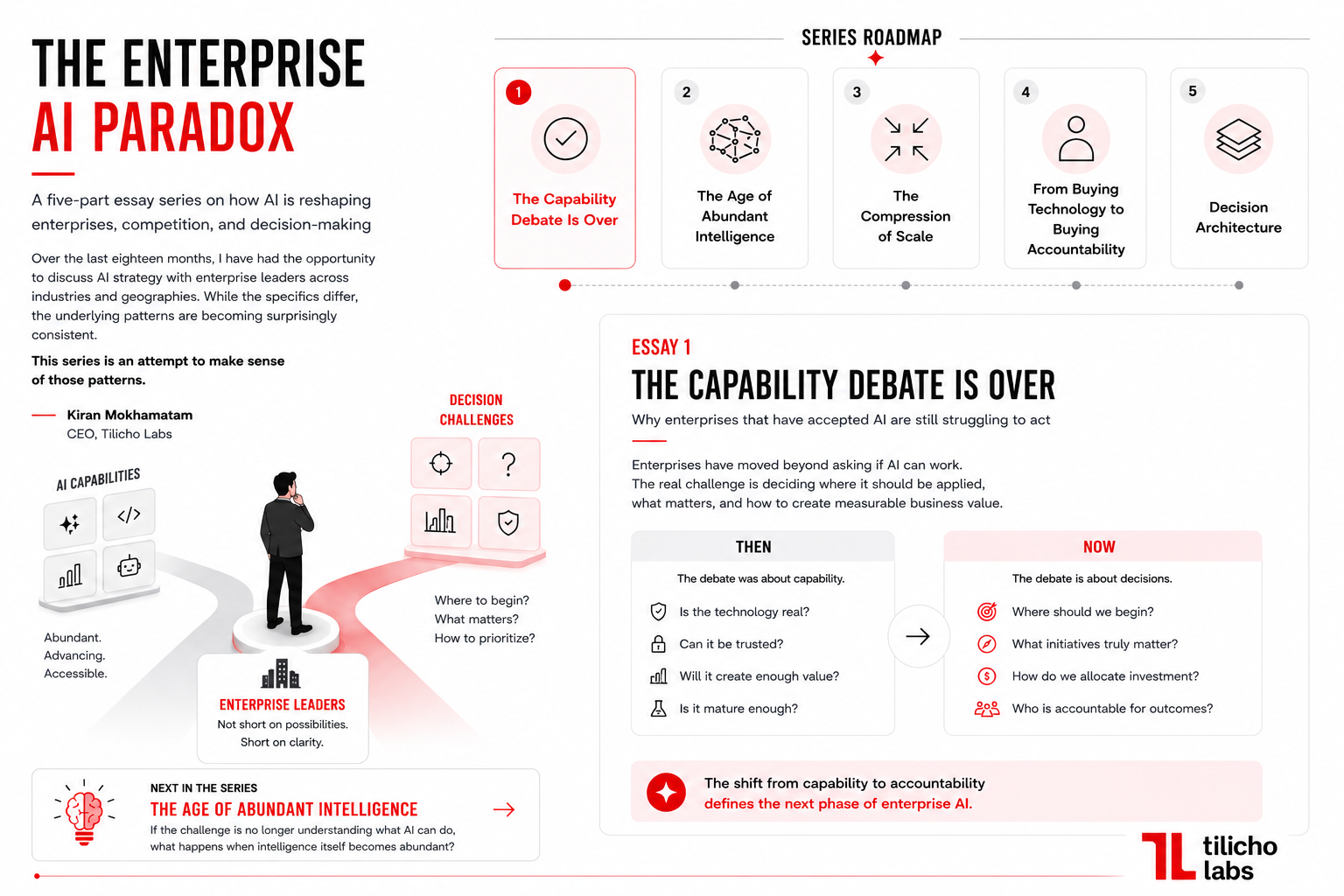
A five-part essay series on how AI is reshaping enterprises, competition, and decision-making
Over the last eighteen months, I have had the opportunity to discuss AI strategy with enterprise leaders across industries and geographies. While the specifics differ, the underlying patterns are becoming surprisingly consistent.
This series is an attempt to make sense of those patterns.
— Kiran Mokhamatam
CEO, Tilicho Labs
Series Roadmap
- The Capability Debate Is Over
- The Age of Abundant Intelligence
- The Compression of Scale
- From Buying Technology to Buying Accountability
- Decision Architecture
Essay 1: The Capability Debate Is Over
Why enterprises that have accepted AI are still struggling to act
Earlier this week, I was presenting AI opportunities to the leadership team of one of Asia's largest energy companies.
The discussion covered a range of topics that have become increasingly common in enterprise AI conversations. We explored how AI could reshape customer engagement, improve loyalty utilization, create more personalized experiences, and automate operational workflows through emerging agentic systems. The specifics were unique to the organization. The themes were not.
What stayed with me after the meeting was not any particular proposal or reaction. It was the realization that I had now seen the same pattern repeated often enough that it no longer felt anecdotal.
The industries have been different. The countries have been different. The executives around the table have been different. Yet the underlying dynamic has remained remarkably consistent.
A few years ago, enterprise AI conversations were dominated by a very different set of concerns. Organizations wanted to know whether the technology was real, whether it could be trusted, and whether it would create enough value to justify meaningful investment. Those were reasonable questions. Most executives were encountering large language models for the first time. The technology was impressive, but its implications were still uncertain.
Today, those conversations feel increasingly distant.
The executives I meet rarely question whether AI will have a meaningful impact on their business. They have already seen enough demonstrations, enough proof points, and enough examples from competitors and technology providers to accept that the underlying capability exists. In many cases, they have already run pilots, funded experiments, or deployed AI in limited parts of their organizations.
Yet despite this growing acceptance, a surprising amount of uncertainty remains.
The uncertainty is simply no longer centered on the technology itself.
Instead, it is centered on decisions.
Where should the organization begin? Which opportunities deserve executive attention? Which initiatives are strategically important and which are merely interesting? How should scarce investment dollars be allocated across dozens, or even hundreds, of potential use cases?
These questions surfaced repeatedly during the discussion. They were not always asked directly. In fact, they often appeared disguised as conversations about governance, procurement, platform selection, organizational readiness, or implementation strategy. But underneath those discussions sat a more fundamental challenge.
The challenge was not understanding what AI could do.
The challenge was deciding what mattered.
This distinction may prove to be one of the defining characteristics of the next phase of enterprise AI adoption.
For much of the past three years, the technology industry has focused on expanding the frontier of capability. Every month seems to bring a more capable model, a new reasoning breakthrough, an improved agent framework, or a fresh benchmark demonstrating progress. The pace of innovation has been extraordinary and there is little reason to believe it will slow down.
At the same time, hyperscalers have invested aggressively to ensure that these capabilities reach enterprises as quickly as possible. Software vendors have embedded AI into nearly every category of enterprise software. Consulting firms have launched AI transformation practices. Startups have emerged to address every imaginable niche.
The result is a marketplace that offers enterprises more AI possibilities than at any point in history.
This abundance is an extraordinary achievement.
It may also be creating an entirely new problem.
Historically, technology strategy was shaped by scarcity. Organizations competed for access to talent, expertise, computing resources, software, and information. The constraints were visible and well understood. Leaders focused their energy on obtaining resources that were difficult to acquire.
AI is beginning to invert that dynamic.
Many organizations are no longer constrained by a lack of possibilities. They are increasingly constrained by their ability to evaluate and prioritize those possibilities. The challenge is shifting from access to allocation.
That shift sounds subtle. I believe it is profound.
Most organizations can generate a long list of potential AI initiatives within a few hours. Customer support, sales enablement, software development, procurement, finance, compliance, marketing, knowledge management, forecasting, pricing, maintenance, and workforce productivity all present plausible opportunities for AI deployment. The list is rarely the problem.
The difficulty emerges when leadership teams attempt to answer a much harder question.
Which of these opportunities genuinely matters?
That question is not a technology question. It is a strategic question.
And strategic questions are often far more difficult than technical ones.
Next in the Series
The Age of Abundant Intelligence
If the challenge is no longer understanding what AI can do, the next question becomes more interesting:
What happens when intelligence itself becomes abundant?
Read Essay 2 →