
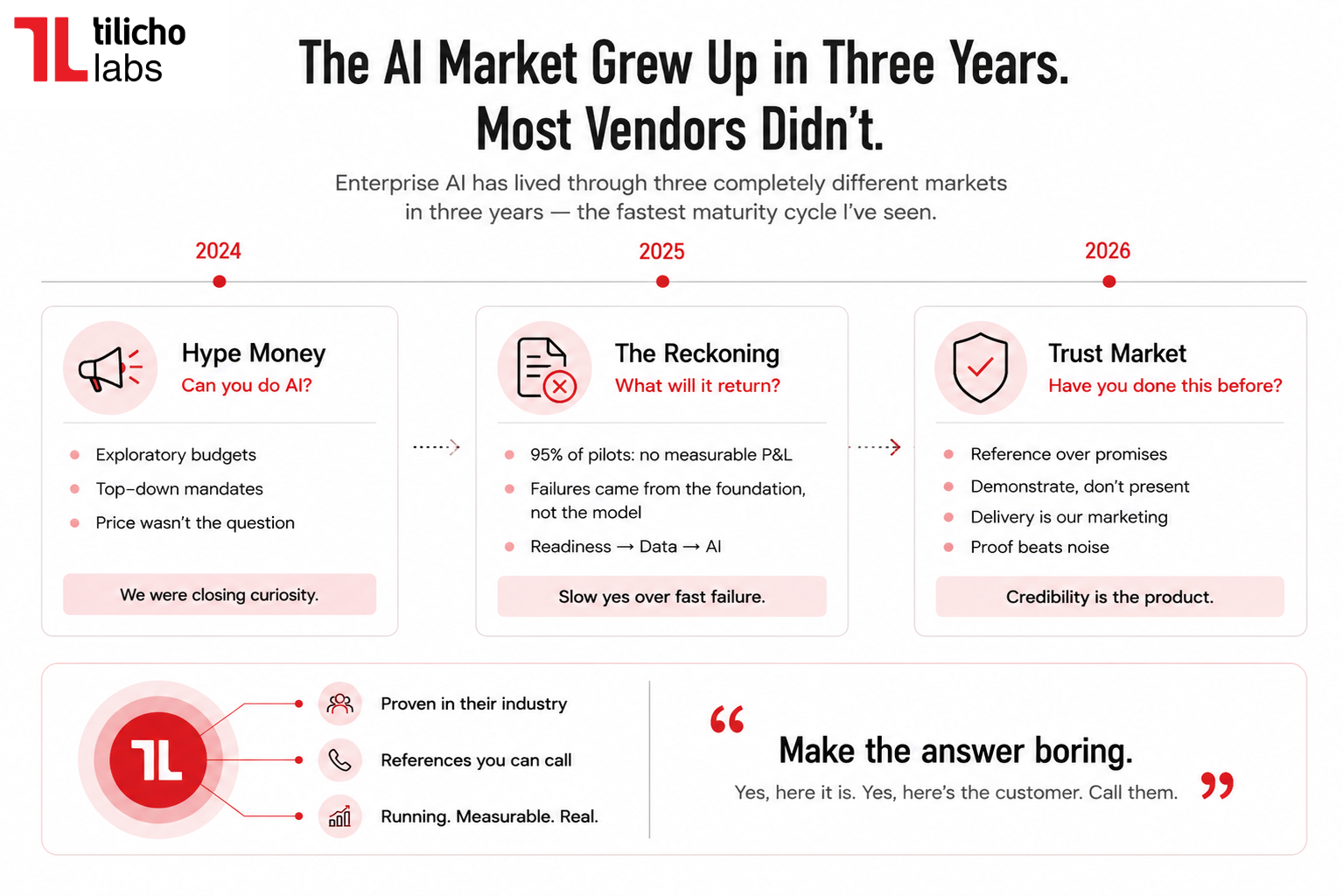
The AI Market Grew Up in Three Years. Most Vendors Didn't.
Enterprise AI has lived through three completely different markets in three years — the fastest maturity cycle I've seen in enterprise technology. Most of what I read about selling and buying AI still describes the first one. This is what I've watched change from the front row — and what we changed because of it.
2024 taught me what hype money looks like
In 2024, the conversations were easy. Budgets were exploratory, mandates came from the top, and the question in the room was "can you do AI?" — never "what will it return?" I remember noticing that nobody negotiated price seriously. That should have been the tell. Menlo Ventures' survey that year found just 1% of enterprise buyers cited price as a selection concern, even as AI spending grew 6x. Nobody haggles over an experiment. We weren't closing customers; we were closing curiosity.
I don't say that with contempt — we took those projects too. But I learned to recognize the difference between a buyer spending innovation budget and a buyer spending their own P&L. Only one of them calls you back next year.
2025 was the invoice for 2024
Then the market did what markets do: it checked the receipts. MIT put a number on what everyone was privately feeling — roughly 95% of generative AI pilots delivered no measurable P&L impact. Companies started walking away from AI initiatives in droves, and analysts traced most of the wreckage to the same root cause: the projects died underneath the AI layer, in data that was never ready to support it.
Here's my honest confession about that period: none of the failures I saw up close were model failures. Not one. They were foundation failures — scattered data, no ownership, no governance — sold a roof by someone who never checked for walls. That year forced a decision on us: stop leading with AI. We now sequence every engagement the same way — readiness first, data engineering second, AI last. It makes for a slower yes. I'll take a slow yes over a fast failure, because I've now seen what a fast failure costs: the reference, the case study, and every deal that would have come from both.
2026 buyers have stopped believing anyone. Good.
The buyer sitting across from me today is a survivor of that reckoning, and I like them much better. They don't ask whether we can build it — everyone claims they can, and the claims have become genuinely indistinguishable. They ask: have you done this before? In my industry? Can I call that customer? Show me it running.
Every one of those questions is a trust question, not a technology question. And I think that's the single most important shift of the three years: capability stopped being the product. Credibility became the product.
This has real consequences for how I run the company:
We stopped presenting and started demonstrating. Slides don't move a 2026 buyer — a working platform does. If a pilot is on the table, it ships in days, not quarters, because slipping a small commitment tells the buyer exactly how the big one will go.
I treat delivery as our marketing department. In a reference-driven market, every project either mints the assets our next deal needs — a reference, a case study, a customer who takes the call — or quietly destroys them. When my engineering bench is overloaded, that's not a delivery problem. It's next quarter's pipeline problem, wearing a disguise.
And I've become allergic to our own industry's noise. Gartner estimates only about 130 of the thousands of self-described agentic AI vendors are real. The lesson for the rest of us isn't to shout louder. It's that in a market drowning in claims, the quietest credible proof wins.
What I'd tell another founder
The market spent three years learning to tell a pitch from a track record. That knowledge doesn't reverse. So the uncomfortable question I'd put to anyone selling AI right now isn't "how good is your AI?" It's: if a skeptical buyer asked to see it running, in their industry, and then call a customer who's lived with it for a year — how does that go for you?
Everything I change in my company these days is in service of one goal: making the answer to that question boring. Yes, here it is. Yes, here's the customer. Call them.
That's the whole strategy. It just took the market three years to make it obvious.