
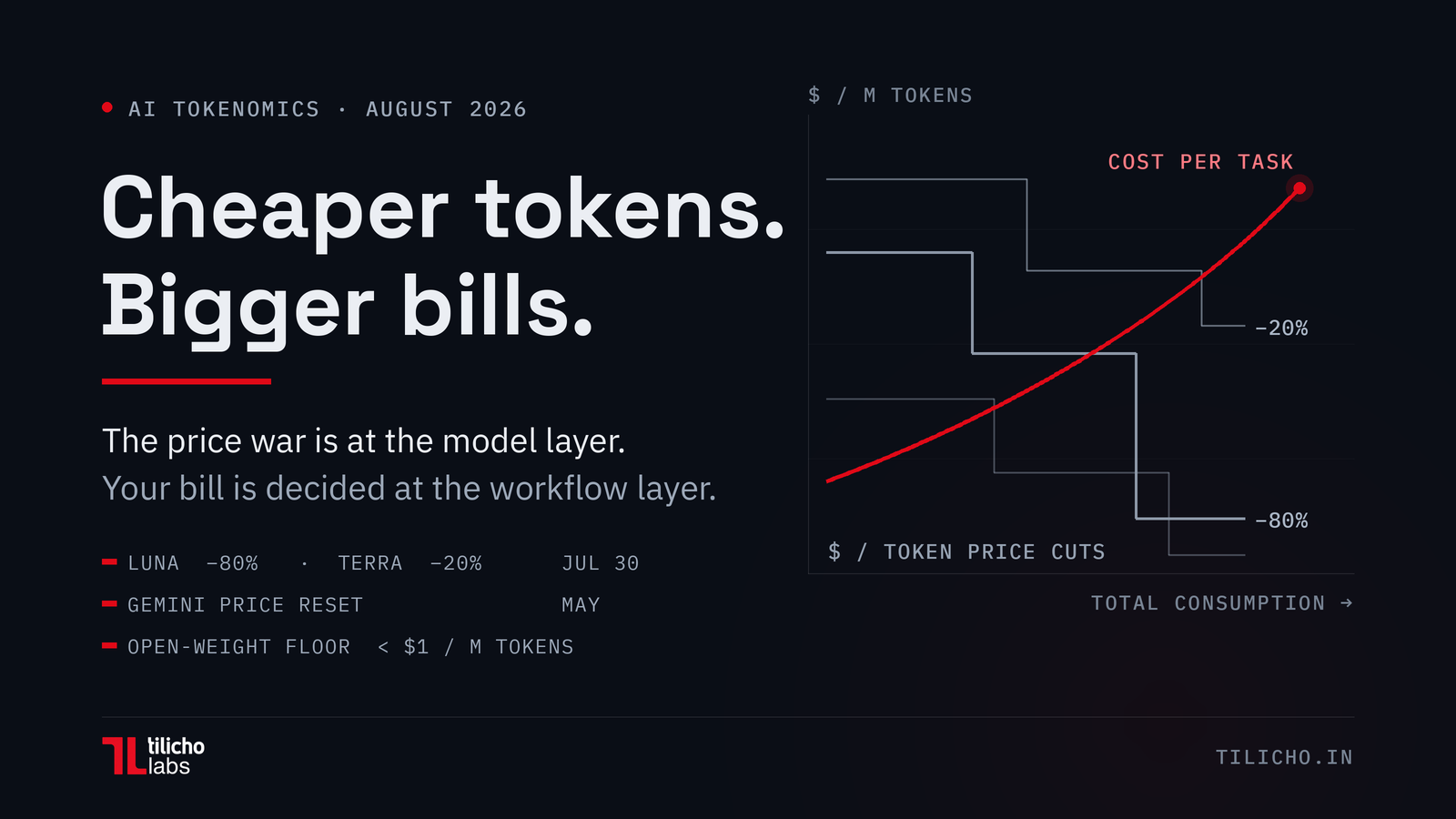
On July 30, OpenAI cut prices on its smaller and mid-tier models. GPT-5.6 Luna, its low-tier model, dropped 80%, from $1.00 to $0.20 per million input tokens and from $6.00 to $1.20 per million output tokens. Terra, its mid-tier model, dropped 20%, to $2.00 in and $12.00 out per million tokens. Sol, the flagship, was untouched.
That single move tells you almost everything about where this industry actually is. Terra now undercuts Anthropic's Claude Sonnet 4.6, which is priced at $3 in and $15 out. Anthropic dominates enterprise and developer usage but sits at the expensive end of the market, and it is being squeezed from two directions at once: American competitors cutting prices, and open-source Chinese models like Z.ai's GLM-5.2 nearly matching frontier performance at a fraction of the cost.
This is not an isolated skirmish. Google reset the market in May, cutting its AI Ultra subscription from $250 to $200 a month and introducing a $100 tier, while positioning Gemini 3.5 Flash as a model that matches Anthropic-level quality at a fraction of the price. Meanwhile, GLM and DeepSeek continue to publish open-weight models at hosted prices well under a dollar per million tokens, forcing every closed-model vendor to defend a shrinking price premium.
Read individually, each of these looks like a vendor being generous. Read together, they are a market signal: token price is no longer a durable differentiator for anyone.
Why everyone is cutting now
Three forces are converging at once, and none of them are permanent.
Capability is arriving faster than demand can absorb it. OpenAI said the Luna and Terra cuts were made possible by efficiency gains in GPT-5.6 itself, meaning the smaller models can now do work that recently required a top-tier system. When capability moves faster than the price curve, the rational move is to cut price and let volume absorb the surplus capacity.
Chinese open-weight models have removed the price floor. GLM and DeepSeek are not chasing the frontier anymore in every category; on many workloads they are close enough that price becomes the tiebreaker. Every closed-model lab now has to justify its premium in the same conversation as a model that costs a fraction as much to run.
The IPO clock is running. Analysts flagged that these cuts, while likely to boost usage, will also strain OpenAI's and Anthropic's finances ahead of highly anticipated public listings. That is a tell. Labs are trading near-term margin for market share and usage metrics that look good in an S-1. That is a financing strategy, not a technology strategy, and it will not survive contact with public-market scrutiny of unit economics.
Put plainly: this is a land grab, not a moat. Every lab is trying to become the default before the market consolidates, using price as the fastest lever available. Land grabs end. Moats don't.
What the price war actually changes for buyers
Here is the part most vendor commentary skips: falling token prices do not mean falling AI bills. Reuters reported the wider trend accurately — as labs shift from flat subscriptions to usage-based pricing, the cost of completing a task is rising even as the per-token price falls, because usage per task is harder to estimate and total consumption keeps climbing.
That is the trap in this moment. A CFO who sees "80% price cut" and assumes the AI line item is solving itself is reading the wrong signal. The unit price war is real, but it is happening at the model layer. The bill is determined at the workflow layer — how many calls, to which model, at what context length, retried how many times, for how long. Cheaper tokens without disciplined routing just make it cheaper to consume tokens carelessly.
| Price war signal | What it looks like | What it actually means for enterprises |
|---|---|---|
| OpenAI cuts Luna 80%, Terra 20% | Smaller models get dramatically cheaper | Routine, high-volume tasks can move down-market without a quality loss |
| Google resets Gemini pricing | Frontier-adjacent quality at commodity price | The "pay more for quality" assumption is breaking down in real time |
| GLM-5.2, DeepSeek undercut both | Open-weight models near frontier performance, far lower cost | A credible self-hosted or fine-tuned tier now exists for cost-sensitive workloads |
| Labs cutting margin ahead of IPOs | Aggressive pricing funded by growth narrative, not unit economics | Today's price is not a reliable input to a 3-year TCO model |
The strategy underneath the tactic
Winning a price war is not a strategy any single lab can sustain, and it is not a strategy any enterprise should try to time. The durable advantage sits one layer up, in how an organization decides which model handles which piece of work, and how tightly it governs what that decision costs.
That means two things have to be built, not bought as a side effect of a vendor relationship.
Orchestrators. No enterprise should be routing every request to a single flagship model by default. The right architecture treats models as interchangeable workers behind a routing layer: commodity and open-weight models for high-volume, low-ambiguity tasks; mid-tier models for the bulk of production workflows; frontier models reserved for the narrow slice of work where their marginal capability actually changes the outcome. An orchestrator that can make that call automatically, per request, is worth more than any single price cut, because it captures every future price cut across every vendor instead of betting on one.
Token economics as a governance discipline, not a finance afterthought. This is FinOps applied to inference: metering consumption by workflow, not by department; setting cost ceilings per task type; tracking cost-per-outcome instead of cost-per-token; and treating a model swap as a routine optimization rather than a migration project. An AI-native company, in the truest sense, is one that can justify every rupee of token spend to its board — not because spend is low, but because it is legible.
Together, orchestration and token-economics governance turn a volatile, vendor-driven price war into a controllable input. When the next price cut lands — and there will be a next one — a company with this layer in place absorbs it as a cost reduction. A company without it just changes which vendor it is dependent on.
What CXOs should actually do
Three moves, in order of priority:
- Stop evaluating AI vendors on flagship-model benchmarks alone. Evaluate them on price-performance across their full model tier, because that is where most enterprise volume actually runs.
- Build or buy a routing layer before the next round of price cuts, not after. The value of an orchestrator compounds every time a vendor reprices, and every lab in this market is currently repricing.
- Instrument cost-per-outcome now, even imperfectly. A rough metric you can improve beats a precise metric you don't have when the board asks what the AI budget is actually buying.
The labs fighting this price war are making a bet that usage and market share today will convert into pricing power later. That may or may not work for them. It is irrelevant to how an enterprise should behave. The companies that come out ahead will not be the ones that picked the cheapest model in August 2026. They will be the ones that built the discipline to keep picking the cheapest capable model, automatically, for every single request, indefinitely.
That discipline is the actual war. Everything else is just this week's headline.