
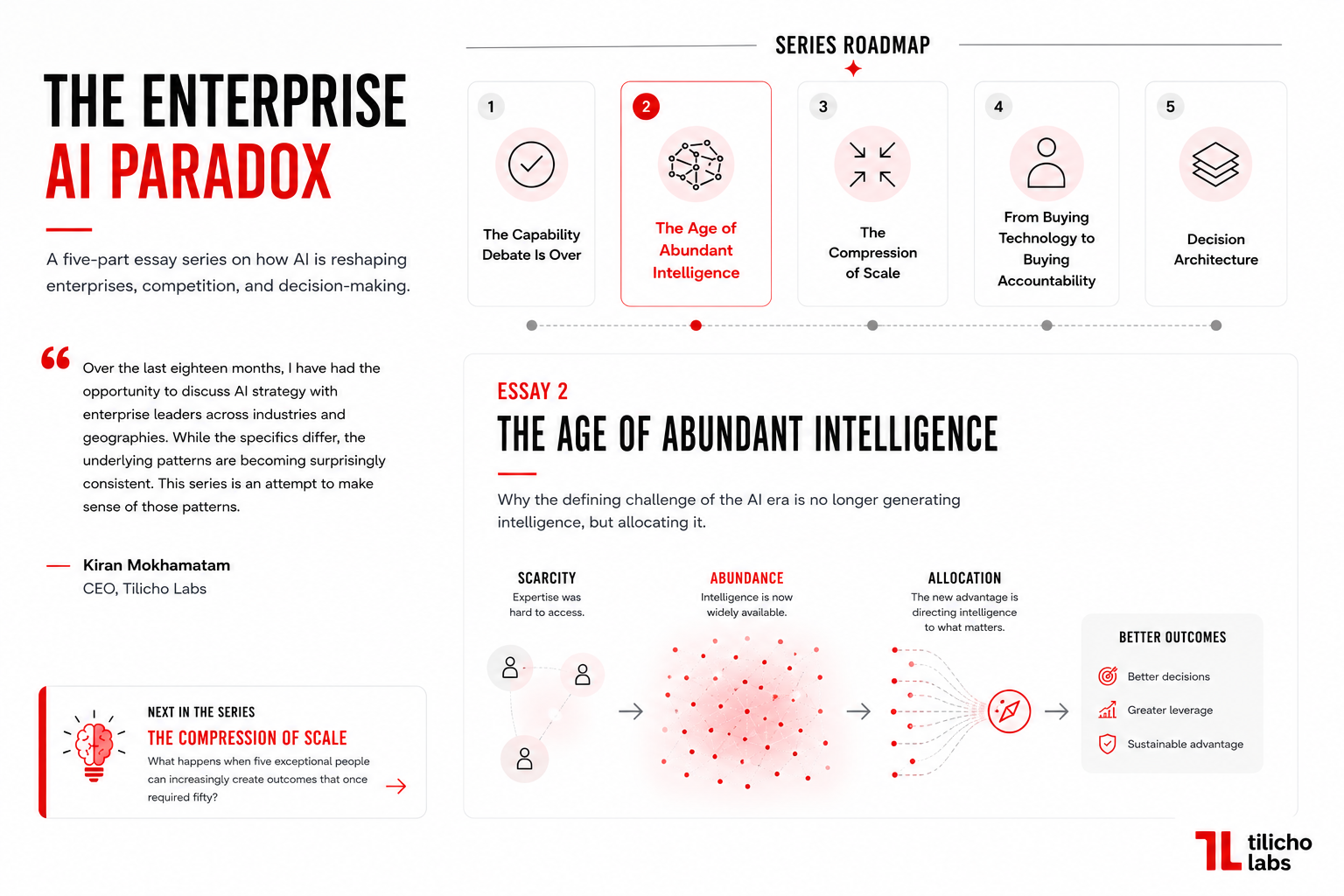
A five-part essay series on how AI is reshaping enterprises, competition, and decision-making
Over the last eighteen months, I have had the opportunity to discuss AI strategy with enterprise leaders across industries and geographies. While the specifics differ, the underlying patterns are becoming surprisingly consistent.
This series is an attempt to make sense of those patterns.
— Kiran Mokhamatam
CEO, Tilicho Labs
Series Roadmap
- The Capability Debate Is Over
- The Age of Abundant Intelligence
- The Compression of Scale
- From Buying Technology to Buying Accountability
- Decision Architecture
Essay 2: The Age of Abundant Intelligence
Why the defining challenge of the AI era is no longer generating intelligence, but allocating it
In the previous essay, I argued that enterprises are entering a new phase of AI adoption.
The challenge is no longer determining whether AI works. Most organizations have already accepted that it does. Nor is the challenge identifying possible use cases. The market offers more AI opportunities than most organizations can realistically evaluate.
Instead, enterprises are increasingly struggling with a different problem: deciding where intelligence should be applied.
At first glance, this may appear to be a prioritization challenge.
I believe it is something deeper.
It is a consequence of abundance.
For most of modern economic history, organizations have been designed around scarcity. Scarcity of capital, scarcity of expertise, scarcity of information, scarcity of computing power, and scarcity of specialized talent shaped how companies were structured and how decisions were made. Entire industries emerged to help organizations acquire, manage, and optimize resources that were difficult to obtain.
The assumption that expertise is scarce sits at the center of modern organizational design.
Consider how most enterprises operate.
When a company faces a complex legal issue, it seeks legal experts. When it encounters a difficult technical problem, it hires engineers or consultants. When it needs strategic guidance, it turns to specialists with years of accumulated experience. Organizations evolved around the idea that deep expertise is both valuable and limited.
This assumption has remained largely unchanged for decades.
AI may be beginning to challenge it.
For the first time in modern history, access to sophisticated reasoning capabilities is becoming widely available. What was once confined to highly trained specialists can increasingly be accessed through software. A manager can obtain analytical support that previously required a team of analysts. A software engineer can leverage capabilities that would once have required multiple specialists. A small startup can perform research, generate content, write software, analyze markets, and build products at a scale that would have been difficult to imagine only a few years ago.
The implications of this shift are easy to underestimate because we are accustomed to thinking about AI as a technology.
The more useful lens may be economic.
Every major economic transformation begins when a previously scarce resource becomes abundant.
The Industrial Revolution did not simply introduce new machines. It dramatically increased access to physical production capacity.
The internet did not merely connect computers. It transformed access to information.
Cloud computing did not introduce computation itself. It made computation available on demand.
In each case, the most important effects were not technical. They were organizational.
When scarcity disappears, the institutions built around managing that scarcity begin to change.
The same dynamic may now be unfolding with intelligence.
Much of the AI industry's attention remains focused on creating increasingly capable models. This focus is understandable. The progress has been remarkable, and significant technical challenges remain.
Yet from the perspective of many enterprises, the most important shift may already have occurred.
Intelligence is no longer inaccessible.
It is increasingly available.
And abundance changes behavior.
When a resource is scarce, organizations compete for access.
When a resource becomes abundant, organizations compete on utilization.
This distinction is critical.
For decades, competitive advantage often came from possessing resources that others could not easily access. Proprietary data, specialized expertise, advanced infrastructure, and exclusive capabilities created defensible positions.
As intelligence becomes more widely available, advantage begins to migrate elsewhere.
Toward judgment.
Toward context.
Toward execution.
Toward governance.
Toward decision-making.
This helps explain a pattern that initially appears contradictory.
Organizations are investing aggressively in AI while simultaneously becoming less certain about where to focus those investments.
The contradiction disappears once intelligence is viewed through the lens of abundance.
Abundance does not automatically create clarity.
In many cases, it creates the opposite.
The internet gave humanity access to unprecedented amounts of information. It also created entirely new challenges around filtering, prioritization, and trust.
Cloud computing made infrastructure dramatically more accessible. It also introduced new questions around architecture, security, governance, and cost management.
AI appears to be following a similar trajectory.
The challenge is shifting from obtaining intelligence to directing it.
This distinction has profound implications for enterprise strategy.
Many organizations continue to evaluate AI primarily through the lens of capability. They compare models, evaluate platforms, assess vendors, and benchmark performance. These activities remain important, but they increasingly resemble table stakes rather than strategic differentiators.
The harder question is determining where intelligence should be deployed inside an organization.
Which decisions deserve augmentation?
Which workflows should remain human?
Which processes create the greatest economic leverage?
Which activities generate sustainable competitive advantage?
These questions sit above technology.
They are questions of organizational design.
And they may become the defining management challenge of the AI era.
This is why I believe many enterprises are misdiagnosing the problem they face.
The problem is not a shortage of intelligence.
The problem is that intelligence is becoming abundant faster than organizations can adapt to it.
The consequences of this shift are only beginning to emerge.
One of the most important is already visible.
As intelligence becomes more accessible, the relationship between talent and scale begins to change.
A small number of highly capable individuals can increasingly achieve outcomes that once required much larger organizations.
This may prove to be one of the most disruptive business consequences of AI.
And it is the subject of the next essay.
Next in the Series
The Compression of Scale
What happens when five exceptional people can increasingly create outcomes that once required fifty?