
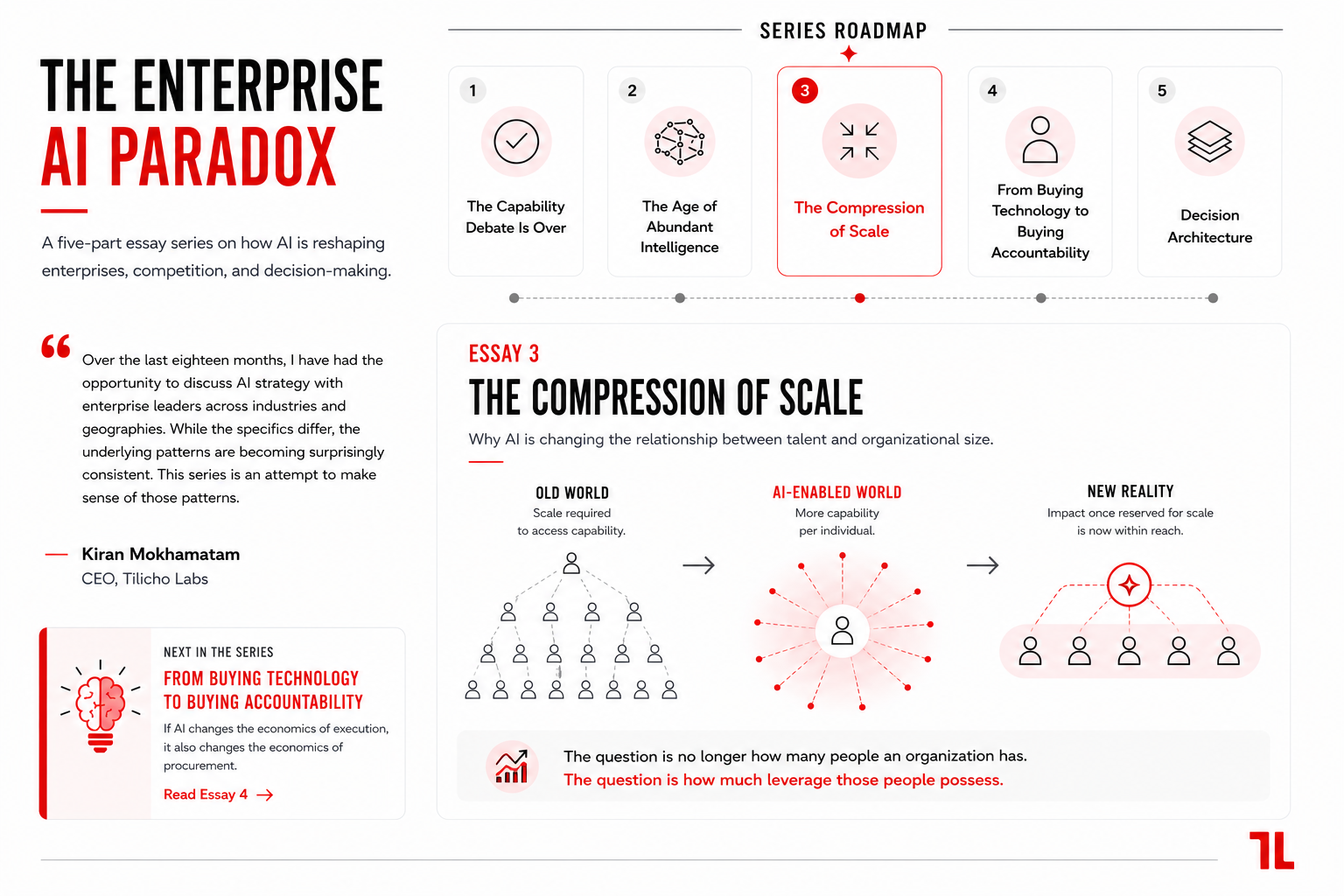
A five-part essay series on how AI is reshaping enterprises, competition, and decision-making
Over the last eighteen months, I have had the opportunity to discuss AI strategy with enterprise leaders across industries and geographies. While the specifics differ, the underlying patterns are becoming surprisingly consistent.
This series is an attempt to make sense of those patterns.
— Kiran Mokhamatam
CEO, Tilicho Labs
Series Roadmap
- The Capability Debate Is Over
- The Age of Abundant Intelligence
- The Compression of Scale
- From Buying Technology to Buying Accountability
- Decision Architecture
Essay 3: The Compression of Scale
Why AI is changing the relationship between talent and organizational size
In the previous essay, I argued that the most important consequence of AI may not be technological. It may be economic.
If intelligence is becoming increasingly abundant, then organizations will inevitably need to rethink assumptions that were built during an era when expertise was scarce.
One of those assumptions concerns scale.
For decades, business leaders have largely accepted a simple relationship between organizational size and organizational capability. Bigger projects required bigger teams. Larger transformations required larger consulting firms. More ambitious products required more engineers. When enterprises encountered complex challenges, the default response was often to add people, add structure, and add process.
This logic was not irrational. It emerged from the realities of the industrial and information ages.
Knowledge was difficult to access. Expertise was expensive to acquire. Research required specialists. Software development required large teams. Market intelligence required dedicated functions. Organizations accumulated people because people represented capability.
AI is beginning to change that equation.
The significance of this shift is often underestimated because discussions around AI tend to focus on productivity. We ask whether developers can write code faster, whether analysts can produce reports more efficiently, or whether marketers can create content at greater speed.
These are important questions.
They are not the most interesting ones.
The more important question is what happens when the leverage available to talented individuals increases dramatically.
Consider what has happened over the last two decades. The internet democratized access to information. A motivated individual today has access to more knowledge than the largest corporations possessed only a generation ago.
AI is taking this process a step further.
It is not merely democratizing information.
It is democratizing expertise.
Tasks that previously required teams of specialists can increasingly be accelerated, supported, or partially executed by intelligent systems. Research can be compressed from weeks into hours. Prototypes can be built in days rather than months. Analysis can be performed at a scale that was previously impractical.
The result is not that expertise becomes irrelevant.
The result is that expertise becomes amplified.
A highly capable engineer can achieve more than before. A strong product leader can evaluate more possibilities than before. A small team can explore opportunities that would previously have required significant organizational investment.
This has profound implications for how we think about scale.
Historically, scale itself was often a competitive advantage. Larger organizations possessed more resources, more specialists, more processes, and more institutional knowledge. While those advantages remain important, they are no longer sufficient explanations for success.
Increasingly, the question is not how many people an organization has.
The question is how much leverage those people possess.
This distinction may seem subtle, but it changes how organizations compete.
A startup with ten exceptional individuals can increasingly challenge organizations that employ hundreds.
A boutique consulting firm can create outcomes that once required much larger institutions.
A small technical team can build products, conduct research, and deploy solutions at a scale that would have been unimaginable only a few years ago.
None of this suggests that large organizations will disappear. Scale still matters. Customer relationships matter. Brand matters. Distribution matters. Operational excellence matters.
What is changing is the relationship between scale and capability.
The gap between large and small is narrowing.
The gap between average and exceptional may be widening.
This is why I believe AI is ultimately less about automation and more about leverage.
The organizations that thrive in the coming decade will not necessarily be those with the largest teams. They will be those that create the greatest leverage for talent.
Technology democratized information.
AI is democratizing expertise.
And as expertise becomes increasingly accessible, organizational scale itself begins to compress.
The implications of that shift are only beginning to emerge.
Next in the Series
From Buying Technology to Buying Accountability
If AI changes the economics of execution, it also changes the economics of procurement.