
A five-part essay series on how AI is reshaping enterprises, competition, and decision-making
Over the last eighteen months, I have had the opportunity to discuss AI strategy with enterprise leaders across industries and geographies. While the specifics differ, the underlying patterns are becoming surprisingly consistent.
This series is an attempt to make sense of those patterns.
— Kiran Mokhamatam
CEO, Tilicho Labs
Series Roadmap
- The Capability Debate Is Over
- The Age of Abundant Intelligence
- The Compression of Scale
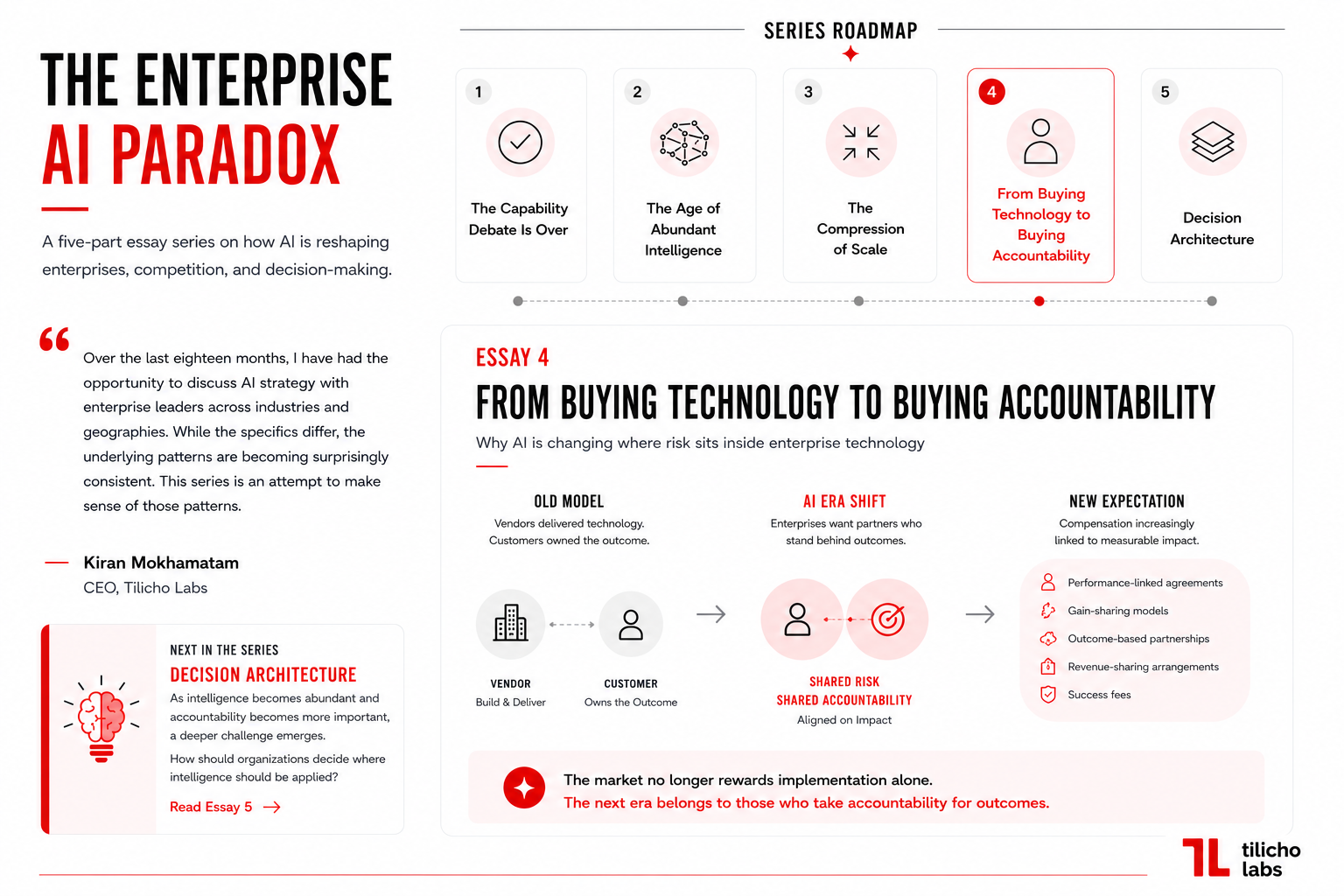
- From Buying Technology to Buying Accountability
- Decision Architecture
Essay 4: From Buying Technology to Buying Accountability
Why AI is changing where risk sits inside enterprise technology
One of the more subtle shifts taking place in enterprise AI conversations has very little to do with models, benchmarks, or architectures.
It has to do with expectations.
For decades, enterprise technology operated under a relatively straightforward commercial arrangement. Vendors sold software. Consulting firms sold implementation services. Systems integrators sold delivery capacity. Customers paid for licenses, projects, development effort, and support contracts.
Success was often measured by implementation milestones. Was the system deployed? Was the migration completed? Were the features delivered? Did the project go live?
Business outcomes certainly mattered, but they were often considered the customer's responsibility.
AI is beginning to challenge that assumption.
Over the past year, I have repeatedly observed a pattern in discussions with enterprises. Organizations appear increasingly indifferent to demonstrations of technical sophistication. The number of patents a company holds, the academic pedigree of its engineers, or the complexity of its architecture rarely become central topics of discussion.
Instead, conversations gravitate toward a different set of questions.
Will this improve customer retention?
Will this increase loyalty utilization?
Will this reduce operational overhead?
Will this improve inventory turns?
Will this accelerate decision-making?
And perhaps most importantly, who is willing to stand behind these outcomes?
This change is understandable.
As intelligence becomes increasingly accessible, enterprises naturally begin to perceive implementation capability as less differentiated. The market already assumes that competent teams can build copilots, agents, recommendation engines, knowledge assistants, and workflow automations.
The question is no longer whether something can be built.
The question is whether it should be built and whether it will create meaningful economic value.
This transition shifts risk.
Historically, vendors assumed implementation risk while customers assumed business risk.
Increasingly, enterprises appear interested in sharing that risk.
If providers genuinely believe their solutions will improve conversion rates, increase productivity, optimize inventory, or reduce churn, why should compensation remain entirely disconnected from outcomes?
This line of thinking is giving rise to new commercial expectations.
Performance-linked agreements.
Gain-sharing models.
Outcome-based partnerships.
Revenue-sharing arrangements.
Success fees.
While these models are not new, AI may accelerate their adoption.
The reason is simple.
The more enterprises perceive intelligence as abundant, the more difficult it becomes to charge premiums for implementation alone.
Execution remains important.
Engineering remains important.
Domain expertise remains important.
But these become necessary conditions rather than sufficient differentiators.
Customers increasingly want confidence.
Confidence that someone understands their business.
Confidence that someone is willing to participate in the risk.
Confidence that someone believes enough in the proposed solution to align incentives accordingly.
This transition will not happen overnight.
Many enterprises still prefer traditional procurement models. Many providers will continue to sell projects, hours, and licenses. Some AI initiatives will always remain exploratory in nature.
Nevertheless, the direction of travel appears increasingly clear.
Technology providers spent the last decade selling access to software.
They may spend the next decade selling accountability.
The organizations that succeed in this environment will not merely build impressive systems.
They will become trusted partners in creating measurable business outcomes.
And as accountability becomes more valuable, another challenge emerges.
If intelligence is abundant and outcomes matter more than implementation, how should organizations determine where intelligence should actually be applied?
That question takes us to the final essay in this series.
Next in the Series
Decision Architecture
As intelligence becomes abundant and accountability becomes more important, a deeper challenge emerges.
How should organizations decide where intelligence should be applied?