
A five-part essay series on how AI is reshaping enterprises, competition, and decision-making
Over the last eighteen months, I have had the opportunity to discuss AI strategy with enterprise leaders across industries and geographies. While the specifics differ, the underlying patterns are becoming surprisingly consistent.
This series is an attempt to make sense of those patterns.
— Kiran Mokhamatam
CEO, Tilicho Labs
Series Roadmap
- The Capability Debate Is Over
- The Age of Abundant Intelligence
- The Compression of Scale
- From Buying Technology to Buying Accountability
- Decision Architecture
Essay 5: Decision Architecture
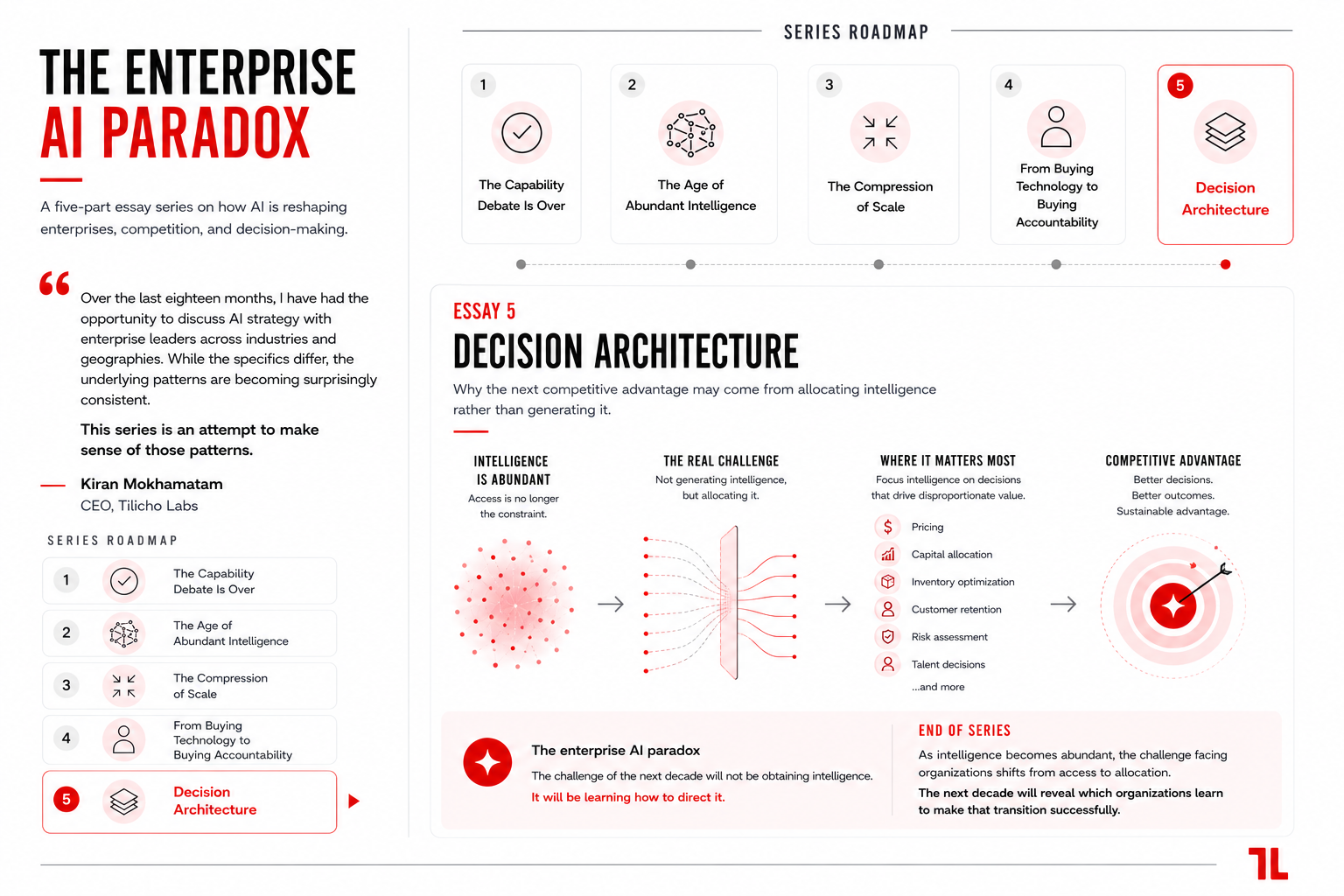
Why the next competitive advantage may come from allocating intelligence rather than generating it
This series began with an observation.
Enterprises are no longer debating whether AI works.
That debate appears to be largely over.
Organizations have seen enough demonstrations, spoken to enough vendors, experimented with enough pilots, and observed enough examples from peers to accept that AI is capable of creating meaningful business value.
Yet despite this growing confidence, enterprises remain uncertain about where to act.
In the first essay, I argued that the bottleneck in enterprise AI is shifting from capability discovery to prioritization.
In the second essay, I proposed that this challenge is a natural consequence of intelligence becoming increasingly abundant.
In the third essay, I suggested that abundant intelligence changes the economics of organizational scale by dramatically increasing the leverage available to talented individuals and small teams.
In the fourth essay, I argued that this abundance is also changing commercial expectations, gradually shifting enterprise conversations from buying technology toward buying accountability.
All of these ideas point toward a deeper realization.
The most important challenge of the AI era may not be generating intelligence.
It may be allocating intelligence.
Most organizations have spent decades refining their process architecture.
They understand workflows.
They understand operational dependencies.
They understand applications.
They understand data.
Entire disciplines have emerged around enterprise architecture, data governance, cybersecurity, and process optimization.
Surprisingly, very few organizations explicitly discuss decision architecture.
This omission is understandable.
Until recently, intelligence itself was scarce.
Organizations focused on acquiring expertise because expertise was difficult to obtain. Companies hired specialists, engaged consultants, built centers of excellence, and developed layers of management to ensure that important decisions benefited from the best available knowledge.
AI challenges that assumption.
If intelligence becomes widely available, organizations no longer need to concentrate solely on obtaining expertise.
Instead, they need to determine where expertise should be directed.
Not every decision deserves augmentation.
Not every workflow deserves automation.
Not every process benefits from autonomous systems.
Some decisions carry little economic consequence.
Others influence millions of dollars in value creation.
Some decisions are repetitive and deterministic.
Others involve ambiguity, judgment, ethics, and context.
The challenge for organizations is not simply deciding whether AI should be used.
The challenge is deciding where AI creates disproportionate leverage.
Pricing decisions.
Capital allocation decisions.
Procurement decisions.
Inventory optimization decisions.
Customer retention decisions.
Risk assessment decisions.
Talent decisions.
These are often the decisions that determine whether organizations outperform competitors.
They deserve more intelligence.
They deserve better intelligence.
They deserve faster intelligence.
This distinction becomes increasingly important as agentic systems mature.
Traditional software executes predefined instructions.
Agentic systems participate in decision-making itself.
They recommend actions.
They evaluate alternatives.
They coordinate workflows.
They initiate activities.
Increasingly, they may act autonomously within predefined boundaries.
As this happens, questions that once appeared technical become organizational.
Which decisions should remain human?
Which decisions can be delegated?
How should autonomous actions be reviewed?
How should accountability be assigned?
How should decisions be audited?
How should organizations manage bias?
How should organizations balance efficiency with governance?
These are not merely engineering questions.
They are management questions.
They are leadership questions.
They are questions about how organizations choose to operate.
Throughout history, organizations competed for scarce resources.
Capital was scarce.
Information was scarce.
Talent was scarce.
Technology was scarce.
The emerging characteristic of the AI era is different.
For perhaps the first time in modern business history, intelligence itself is becoming abundant.
And when a scarce resource becomes abundant, competitive advantage inevitably migrates elsewhere.
It migrates toward judgment.
Toward prioritization.
Toward governance.
Toward incentives.
Toward organizational design.
And ultimately, toward decisions.
The organizations that thrive over the next decade may not be those with access to the most powerful models.
Those capabilities will increasingly become accessible to everyone.
The winners may instead be organizations that systematically identify their highest-leverage decisions and allocate intelligence to them more effectively than anyone else.
That, I believe, is the enterprise AI paradox.
The challenge of the next decade will not be obtaining intelligence.
It will be learning how to direct it.
End of Series
The Enterprise AI Paradox explored a simple idea:
As intelligence becomes abundant, the challenge facing organizations shifts from access to allocation.
The next decade will reveal which organizations learn to make that transition successfully.