
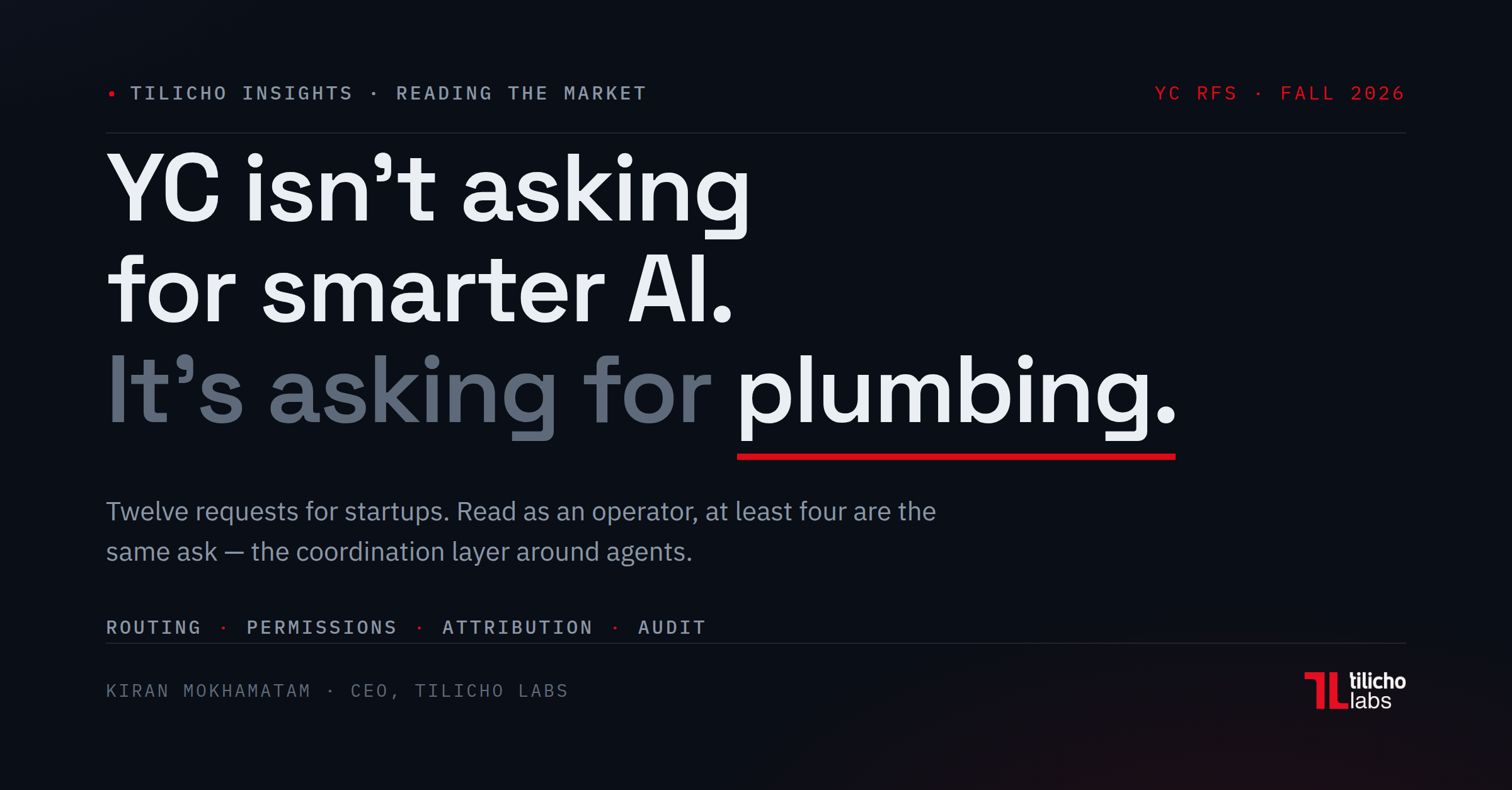
YC published its Fall 2026 Requests for Startups — twelve asks, including, for the first time, one from the sitting US Secretary of the Army.
Most people will read it as a list of startup ideas. I read it as a demand signal. And the signal is not "build a smarter model."
Look at four of the asks side by side.
Multiplayer AI: agents an entire team can watch, redirect, and hand off mid-run. A cloud for small software: deploying and sharing agent-built tools without dragging AWS-grade complexity behind them — with auth and permissions named explicitly as the hard part. Self-maintaining APIs: when a vendor ships a breaking change, an agent scans customer codebases and opens the PR itself. AI-native compliance: monitoring, anomaly flagging, and audit trails across regulatory regimes.
Strip the packaging and it's the same request four times: the coordination layer around agents. Routing. Permissions. Shared state. Attribution. Audit. Plumbing.
Nobody in that list is asking for more intelligence. The intelligence is assumed.
This matches what we live inside enterprise accounts every week. The model call stopped being the hard part somewhere in 2025 — that's my field observation, not a survey. What breaks in production is everything around it: which actor picked up the job, what it cost to complete — not per token, per completed task — who is allowed to redirect a running session, and what the audit trail says when a CFO or a regulator asks. We rebuilt our entire engagement model around four verbs — govern, compress, route, measure — because that is where every deployment actually stalls. The chat box is a single-player interface bolted onto a multiplayer problem. YC has now said this out loud.
The physical-world asks sharpen it further. The request for new operating systems for deskless industries lands on one sentence that could be lifted straight out of our architecture reviews: how do you route a job between an agent, a robot, and a person? That is not a robotics question. That is an orchestration question that happens to have a robot on one leg of the graph.
Even "Proving You're Human" — anchored in the widely reported Arup case, where a finance employee wired out roughly $25 million after a video call in which every other participant was a deepfake — is the same layer inverted. Once agents act on people's behalf, knowing which actor did what stops being fraud prevention and becomes core infrastructure.
Here's the part I'd underline for anyone building right now.
RFS lists are lagging indicators dressed as leading ones. YC writes them after its partners watch the same gap surface across hundreds of companies. So the honest reading is: the market has already spent two years discovering that agent capability outruns agent coordination, and the venture stack is now pricing that in.
The temptation is to build model-layer magic anyway, because it demos well. Resist it — but go in with eyes open. Plumbing sells slower. There is no jaw-drop demo for an audit trail; the sales cycle runs through security review, not through applause. That is the cost of building at this layer, and it is worth paying, because the demo era rewarded intelligence and the deployment era pays for accountability. Agent identity, cost attribution, permission models, hand-off protocols. It doesn't look like the future. It looks like plumbing. It always does — right before everything else has to run through it.
If your 2027 roadmap says "smarter agent," you are competing with every frontier lab's next release. If it says "agents a team can share, meter, audit, and trust," you are building what the buyer — and now the biggest accelerator on the planet — is explicitly asking for.